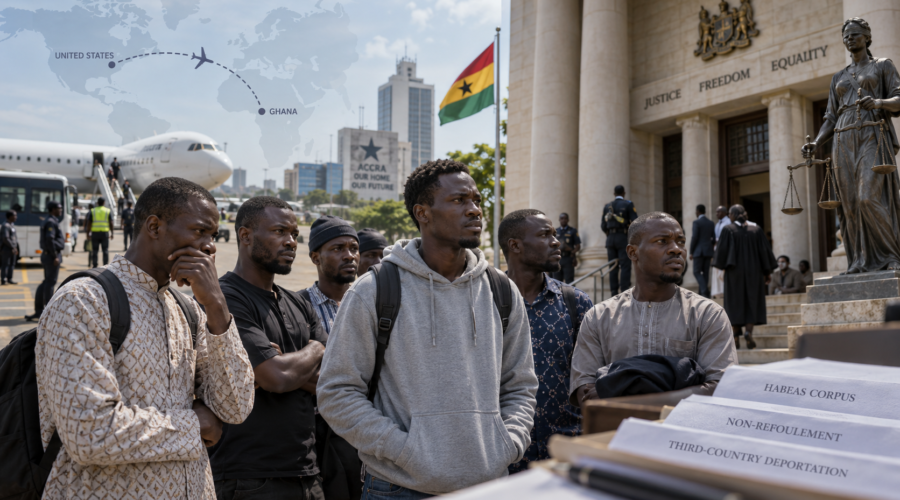
ACCRA, Ghana, September 18, 2025 — Eleven West African nationals deported by the United States to Ghana have turned to Ghana’s courts, challenging their detention and seeking to prevent authorities from sending them onward to countries where several had already been found by U.S. immigration judges to face serious risks of torture, persecution or inhumane treatment.
The case presents an early legal challenge arising from the expanding U.S. policy of third-country deportations, under which migrants may be removed to countries other than their own.
According to a September 18 report by GBC Ghana Online, the eleven victims have filed proceedings against the Government of Ghana alleging unlawful detention and seeking both habeas corpus relief and an interim injunction against further deportation. Read the original GBC Ghana Online report
The High Court in Accra is scheduled to consider the two applications on September 23.
The litigation could have consequences extending well beyond the eleven people detained in Ghana. At least eight of them, according to their lawyers, had previously received Withholding of Removal or Deferral of Removal under the Convention Against Torture, commonly known as CAT protection, from U.S. immigration judges.
That fact creates an unusual legal sequence:
The United States determined that certain individuals could not lawfully be returned to their countries of nationality because of the danger awaiting them there. The United States then deported them to Ghana. Ghana may now send some of them to those same countries.
The resulting dispute raises a fundamental question about modern third-country deportation arrangements: can a government avoid its own prohibition against returning a protected person to danger by first transferring that person to another country?
Victims seek habeas corpus and injunction in Ghana
The eleven applicants are asking the High Court to examine whether Ghana has any lawful basis for continuing to hold them.
GBC Ghana Online reported that their attorney, Oliver Barker-Vormawor, told the court their release was a “matter of urgency.”
The first application seeks a writ of habeas corpus, a judicial remedy requiring the authorities responsible for detention to produce the detainees and establish a lawful basis for holding them.
The second seeks an interim injunction preventing Ghana from deporting the eleven applicants to their respective countries while their case remains before the court.
The applicants have sued Ghana’s Attorney General, Chief of Defence Staff and Comptroller General of the Ghana Immigration Service.
According to the GBC report, the applicants say they were removed from U.S. immigration detention on September 5 and 6, 2025, placed in restraints and flown to Ghana without adequate notice or explanation of where they were being taken. After arriving, they were transferred to Ghanaian custody and allegedly confined at what their filings describe as a military facility.
Their affidavit alleges that they have been held “without due process or judicial oversight.”
The applicants argue that their detention violates Article 14(1) of Ghana’s 1992 Constitution, which protects personal liberty, as well as Article 23’s requirements concerning administrative justice. They are seeking enforcement of their fundamental rights under Article 33(1).
Eight victims reportedly had U.S. protection from return
The most consequential part of the case may concern the immigration status of several members of the group before the United States sent them to Ghana.
According to GBC Ghana Online, attorneys for the victims say at least eight of the eleven had been granted either Withholding of Removal or Deferral of Removal under the Convention Against Torture by U.S. immigration judges.
These forms of protection are important because they generally arise after an adjudicator determines that an individual cannot lawfully be removed to a particular country because of the danger he or she faces there.
Withholding of removal protects a person when the applicable legal standard establishes a sufficient likelihood of persecution in the designated country.
Deferral of removal under the Convention Against Torture protects a person from removal to a country where the person is more likely than not to be tortured.
Neither form of relief necessarily gives the individual an unrestricted right to remain permanently in the United States. U.S. immigration law can permit removal to another country under certain circumstances.
That is what makes third-country deportation legally distinct from direct deportation to the protected person’s home country.
But Ghana’s role creates another question.
If the United States cannot return a person directly to Country A because an immigration judge determined that the person faces torture there, what happens when the United States instead sends that person to Country B and Country B then sends him to Country A?
The answer may implicate the international prohibition against refoulement.
Ghana deportation case raises non-refoulement concerns
The principle of non-refoulement prohibits states, under applicable refugee and human-rights regimes, from transferring people to places where they face certain forms of persecution, torture or other prohibited treatment.
The eleven applicants expressly invoke non-refoulement in their Ghana litigation. GBC reports that they contend their rights under that principle have been threatened by both the circumstances of their detention and the possibility of further deportation.
The issue is especially significant for the applicants who already obtained protection from U.S. immigration courts.
Those decisions are not automatically binding on Ghanaian courts or immigration authorities. But they may constitute significant evidence that a formal judicial process has already examined the danger of returning particular individuals to particular countries.
The case therefore presents more than a dispute over detention.
It raises the possibility of what international protection law sometimes describes as indirect or chain refoulement, where a person is transferred first to an intermediate country and subsequently transferred from that country to the place where the underlying danger exists.
In practical terms, the route could look like this:
United States → Ghana → country of persecution or torture.
That sequence is materially different from a conventional deportation in which Ghana simply receives one of its own nationals or facilitates voluntary regional travel.
Who are the 11 West African victims?
According to the names and nationalities published by GBC Ghana Online, the applicants include nationals of Nigeria, Liberia, Togo, The Gambia and Mali.
They are identified as Daniel Osas Aigbosa, Ahmed Animashaun, Ifeanyi Okechukwu and Taiwo K. Lawson of Nigeria; Kalu John of Liberia; Zito Yao Bruno and Agouda Richarla Oukpedzo Sikiratou of Togo; Sidiben Dawda of The Gambia; and Toure Dianke and Boubou Gassama of Mali. GBC’s published list contains eleven applicants, although the nationality description accompanying some of the names is not entirely clear.
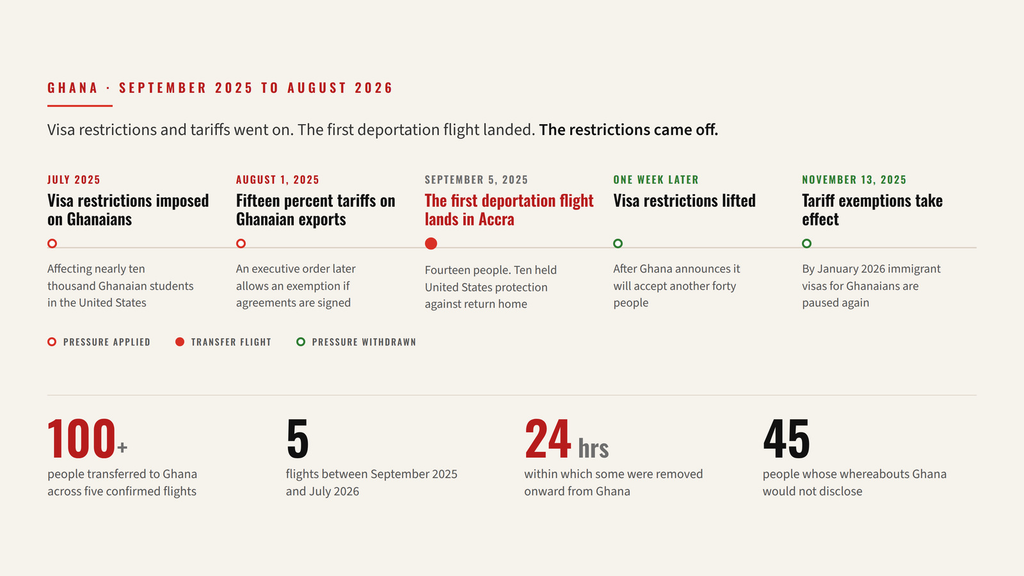
The eleven were part of a larger group of 14 West Africans accepted by Ghana after deportation from the United States.
President John Dramani Mahama had publicly confirmed that Ghana agreed to receive West African nationals deported by the United States, explaining that regional free-movement arrangements made it possible for certain West Africans to enter Ghana and subsequently travel to their countries of nationality.
Associated Press reported on September 11 that Ghana had received 14 victims under the arrangement, including Nigerian and Gambian nationals.
Ghana’s participation places it among a growing group of African countries that have received people deported by the United States to countries other than their own.
U.S. third-country deportations expand beyond Ghana
The Ghana case is part of the Trump administration’s broader expansion of third-country removals from the United States.
Rather than limiting deportations to an individual’s country of citizenship, the administration has pursued arrangements under which other governments agree to receive noncitizens removed from the United States.
African countries involved in such arrangements have included Ghana, Rwanda, Eswatini and South Sudan.
The policy has generated particular concern when the victim has little or no connection to the receiving country, when the terms of the bilateral arrangement are not publicly available, or when the individual has already established a legal entitlement to protection against removal to his or her homeland.
The eleven victims’ case in Accra combines all three issues.
They were removed from the United States to a third country. They challenge the legality of their subsequent detention there. And at least eight allegedly possessed formal U.S. protection against return to their countries of nationality.
Third-country removal does not necessarily end the risk of torture
The Ghana litigation illustrates a structural problem with third-country deportation that may receive increasing attention as the United States expands the practice.
A U.S. immigration court can prohibit the government from returning an individual to a particular country without necessarily preventing removal elsewhere.
From the perspective of U.S. immigration law, sending the individual to Ghana rather than the protected country may therefore be legally distinct from violating the original withholding or CAT order.
But the danger identified in the U.S. proceeding does not disappear when the individual crosses Ghana’s border.
If Ghana subsequently removes the individual to the country from which the United States was prohibited from returning him, the physical result may be precisely the same:
the protected person ends up in the country where a court previously determined that he faces persecution or torture.
The legal responsibility for that outcome may be divided among different states and governed by different domestic and international rules. The human consequence is not.
That is why the Ghana case may become important in the developing law and policy surrounding U.S. third-country deportations and non-refoulement.
September 23 hearing could test Ghana’s role in U.S. deportation policy
The immediate issue before the High Court is narrower.
The applicants want the Ghanaian government to produce them before a court, justify their detention and refrain from removing them before their legal claims can be heard.
GBC Ghana Online reports that the September 23 proceeding will address the habeas corpus application and the request for interim injunctive relief. The broader constitutional case concerning the applicants’ fundamental rights is expected to proceed after those preliminary applications are determined.
For the eleven West African victims, the hearing may determine whether they remain in Ghana long enough for a court to examine the legality of what has happened to them.
For governments pursuing third-country deportation agreements, however, the question is considerably broader.
When one country is legally prohibited from returning a person to danger, can it transfer that person to another country without ensuring that the second country will not complete the prohibited return?
The litigation now unfolding in Ghana may provide one of the first judicial tests of that question arising from the United States’ expanding third-country deportation program.
Source: Barbara Kumah, “11 deported African nationals sue Ghana for alleged unlawful detention; Court to hear application on September 23,” GBC Ghana Online, September 18, 2025. Read the GBC Ghana Online article