BOSTON, January 14, 2026 — One year after the United States placed 14 West African migrants on a military cargo plane bound for Ghana, a federal court filing provides one of the most detailed accounts yet of what happened after they arrived.
The 22-page filing, submitted as Exhibit G in the nationwide third-country removal litigation D.V.D. v. U.S. Department of Homeland Security, contains a sworn declaration from immigration attorney Patrick Taurel and supporting declarations from several of the victims. It describes a system in which migrants were first removed by the United States to Ghana and then, in several cases, transferred by Ghana to countries where U.S. immigration judges had already determined that they faced persecution or torture.
Taurel, a partner at Grossman Young & Hammond, states that his firm represents 11 of the people before the United Nations Committee Against Torture. According to his declaration, none of the 14 people deported on September 5, 2025 was Ghanaian. They came from Nigeria, The Gambia, Togo, Mali and Liberia, and at least 10 had previously received fear-based protection from removal to their countries of origin.
The declaration is evidence submitted by the plaintiffs, not a judicial finding that every allegation in it is true. But it was made under penalty of perjury and incorporates accounts obtained from the victims, their relatives and their immigration lawyers. Its significance extends beyond the treatment of a single group of migrants. It provides evidence of what can happen after a third-country transfer leaves the person in the custody of another government.
Fourteen people taken from Louisiana to Ghana
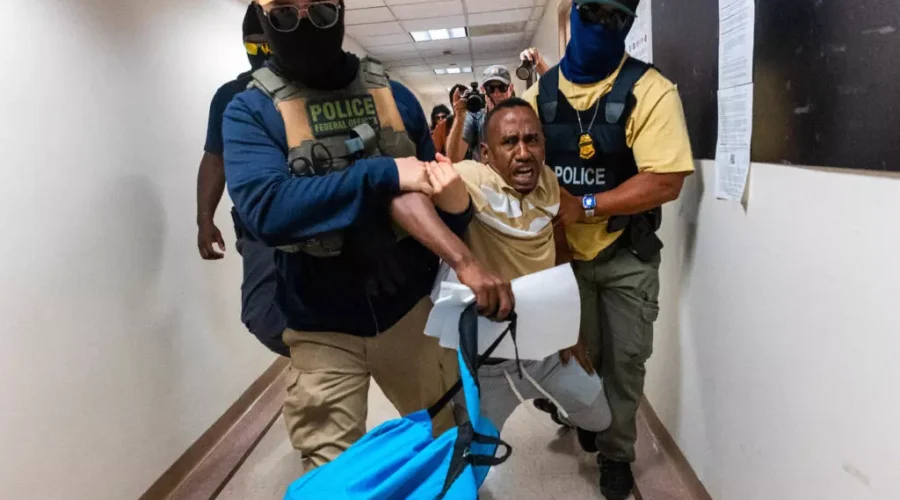
According to the filing, ICE officers removed the 14 people from immigration detention facilities on September 5, shackled them at their wrists, waists and ankles, and placed them aboard a military cargo aircraft departing from Alexandria, Louisiana.
At least four were reportedly placed in WRAP full-body restraints. Some learned that Ghana was their destination only while boarding the aircraft or after it had taken off. Several told U.S. officials they feared being sent to Ghana, according to Taurel, but were told that officials were carrying out orders and that Ghana would subsequently send them to their countries of origin.
Only one of the 14 had any identified connection to Ghana, the declaration says. None had travel documents.
Those facts are especially significant because U.S. immigration law does not generally prohibit the government from removing a person with withholding or CAT protection to every other country in the world. The protection is country-specific. Federal regulations expressly permit removal to a third country other than the country to which removal has been withheld or deferred.
The legal problem becomes much different, however, if the third country is effectively serving as a transit point for onward removal to the very country from which the United States has granted protection.
That is what the December filing alleges occurred in Ghana.
CAT protection against The Gambia, then deportation to The Gambia
One of the clearest examples involves K.S., a Gambian man who had received deferral of removal under the Convention Against Torture in March 2025 because of the danger he faced on account of his sexuality.
K.S. states that after arriving in Ghana he was detained at the Accra airport for five days. He repeatedly told Ghanaian immigration officials that an American immigration judge had protected him from return to The Gambia and asked to remain in Ghana.
According to his declaration, a Ghanaian official told him that his final destination remained The Gambia based on instructions involving ICE and Ghanaian authorities. Ghana ultimately placed him on a flight to The Gambia on September 10. He said Gambian officials initially questioned the validity of the travel documents accompanying him, but he was eventually permitted to enter.
He then went into hiding.
The sequence is legally important. The United States did not itself put K.S. on a plane from Louisiana directly to The Gambia. Instead, it sent him to Ghana, after which Ghana sent him to the country against which a U.S. immigration judge had already granted CAT protection.
That sequence presents what refugee and human-rights law often describes as indirect or chain refoulement: transfer to an intermediate country followed by onward removal to the place of feared persecution or torture.
Woman with CAT protection returned to Nigeria after two decades under supervision
The filing contains a second particularly striking account.
E.A., a Nigerian woman, states that an immigration judge granted her CAT deferral in 2002 because she faced persecution and torture connected to her refusal to undergo female genital mutilation.
She was subsequently released under an Order of Supervision and reported to ICE annually for approximately 20 years. According to her declaration, ICE told her in 2022 that she no longer needed to report.
That changed on July 15, 2025, when ICE officers came to her home and arrested her. She remained in immigration detention for approximately six weeks in Texas before being transferred to Louisiana.
E.A. says she repeatedly reminded ICE officials that she could not be deported to Nigeria and that her ICE case manager acknowledged that the United States could not send her there directly.
On September 5, she was placed on the same military cargo flight to Ghana.
After arrival, she again informed Ghanaian authorities about her CAT protection and asked whether she could remain in Ghana. According to her declaration, officials told her she could not stay because she lacked a visa or other documentation.
After approximately 12 hours at the airport, Ghanaian officials drove her to the border with Togo, gave her 1,500 Ghanaian cedis, approximately $120 at the time, and paid taxi drivers to transport her through Togo toward Nigeria.
She stated that she was subsequently hiding in Nigeria because she feared for her life.
The account is particularly consequential for the growing litigation surrounding ICE re-detention. It describes a person who had lived in the community for roughly two decades under immigration supervision after receiving CAT protection, only to be arrested again and ultimately returned, through Ghana, to the country from which that protection had been granted.
Eleven others taken to a Ghanaian military camp
The remaining 11 victims were transported to what the filing identifies as Bundase Training Camp, also referred to by the victims as Dema Camp.
Taurel describes unreliable electricity, internet and running water, poor food and water, snakes and mosquitoes, and continuous surveillance by armed guards. The group remained there for nearly two weeks.
One detainee, D.A., stated that he had received withholding of removal to Nigeria after an immigration judge found that he faced persecution or death there. He alleged that ICE officers tightly restrained him before the Ghana flight after he objected to being placed aboard and asked to contact his lawyers.
His declaration says the restraints caused substantial swelling in his legs and difficulty walking. While detained in Ghana, he was told that representatives of the victims’ countries would come to the camp and that the migrants would soon be removed.
By September 18 and 19, according to Taurel, Ghana had forced 10 of those detainees across the border into Togo.
Among them were two Togolese women who had previously received withholding of removal to Togo based on persecution connected to their opposition to female genital mutilation. Both subsequently went into hiding, according to the declaration.
Another woman, D.T., had received withholding of removal to Mali because of persecution related to her opposition to female genital mutilation. Taurel states that after Ghana forced her into Togo, she was kidnapped and sexually assaulted there. She escaped and ultimately went into hiding in Mali, the country against which the United States had granted her protection.
A second Ghana flight followed in November
Perhaps the most important part of the declaration is that the September flight was allegedly not an isolated occurrence.
Taurel states that his firm learned of another U.S. deportation flight that left around November 6, 2025 and arrived in Accra. The filing indicates that nine victims were initially confined under armed guard at a hotel in the Greater Accra Region.
On November 11, according to the declaration, Ghanaian authorities removed R.K. from the hotel and deported her to Sierra Leone despite her repeatedly telling officials that a U.S. immigration judge had granted her withholding of removal to that country based on her political opinion.
The remaining eight were then moved from the hotel to a detention camp.
M.M., who had received withholding of removal to The Gambia, was sent there on November 14 and was reported to be hiding in fear for his life.
M.G. was subsequently removed to Senegal. According to the declaration, he had received protection against removal to Senegal under CAT and had informed Ghanaian officials about his documented fear of torture there.
Independent flight monitoring later reported that the United States conducted multiple removals to Ghana during this period and identified the November 6 flight as another forced third-country transfer carrying non-Ghanaians.
Ghana had given the United States diplomatic assurances
The allegations are particularly significant because the United States had told a federal court that Ghana provided diplomatic assurances concerning the treatment of the victims.
During earlier litigation brought by five members of the September group, government counsel told U.S. District Judge Tanya Chutkan that the State Department had received assurances from Ghana that the victims would not be tortured and would not be sent somewhere they would face torture.
When the court asked whether Ghana appeared to be violating those assurances based on what the plaintiffs were reporting, government counsel acknowledged that, assuming the allegations were correct, it appeared so.
The federal government nevertheless maintained that the initial transfer to Ghana was lawful and argued that the court lacked authority to compel a foreign government or direct the Executive Branch’s dealings with Ghana. Judge Chutkan ultimately denied emergency relief on jurisdictional grounds rather than deciding that the alleged onward removals were lawful.
Ghana, for its part, publicly defended the arrangement. Its Information Services Department said the government accepted West African victims under an understanding with the United States and described the program as involving people who could travel within the region under West African free-movement rules. Ghanaian officials also said the first victims had been assisted in returning to their countries of origin.
The federal filing gives that phrase, “returning to their countries of origin,” a very different legal significance when applied to people whose immigration court orders expressly protected them from those countries.
The Ghana evidence goes to the heart of the third-country removal dispute
The December declaration was filed in D.V.D., the nationwide class action challenging DHS procedures for deporting people to countries that were not previously designated during their immigration proceedings.
In February 2026, U.S. District Judge Brian E. Murphy entered judgment setting aside the government’s third-country removal policy and concluded that class members were entitled to meaningful notice and a meaningful opportunity to raise country-specific protection claims before removal. That judgment was subsequently stayed by the First Circuit while the government appealed.
The appeal remained pending in late August 2026.
The Ghana declaration illustrates why that litigation concerns more than the safety of the immediate third country.
A person protected from Nigeria may be sent to Ghana. A person protected from The Gambia may also be sent to Ghana. On paper, neither transfer necessarily violates a country-specific withholding or CAT order because Ghana is not the protected country.
But if Ghana then sends the person to Nigeria or The Gambia, the intermediate transfer can become the mechanism through which the protection is defeated.
That is the larger significance of Exhibit G. It documents allegations not merely of third-country deportation, but of what happened after the United States surrendered physical custody to the third country.
For migrants whose immigration cases had already produced judicial findings of likely persecution or torture, the difference was not theoretical. According to the sworn record now before the federal courts, several ultimately found themselves hiding in the very countries from which American immigration judges had ruled they should be protected.