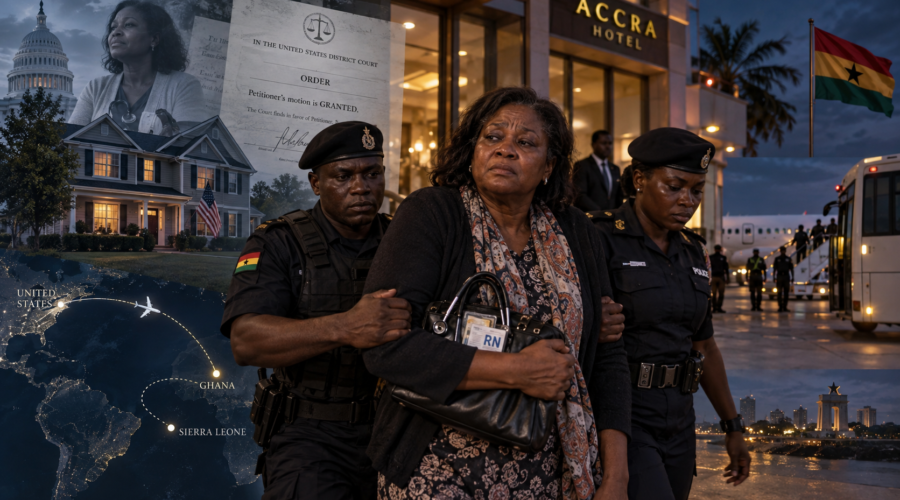
On September 17, 2025, an immigration judge in Louisiana granted Rabbiatu Kuyateh withholding of removal to Sierra Leone. Both sides waived appeal, so the finding was final. Forty-nine days later, the United States put her on an aircraft to Ghana without telling her where she was going, and six days after that, Ghanaian officers dragged her out of a hotel and flew her to Sierra Leone. Her lawyer’s account of it is sworn, and part of it was filmed.
ACCRA. Rabbiatu Kuyateh is fifty-eight. She left Sierra Leone about thirty years ago during its civil war, settled in the Washington area, worked as a nurse with authorization to do so, owned a house in Bowie, Maryland, and raised a son who was born in the United States. She attended her immigration check-ins for nearly two decades. In July 2025, she went to one of them and was detained.
What happened between that check-in and her removal is set out in a declaration by her attorney, Hannah Bridges of Murray Osorio PLLC, signed under penalty of perjury on December 4, 2025 and filed four days later in the Massachusetts case that has become the principal challenge to third-country removals. The declaration identifies her by her initials. She has since spoken publicly under her own name to NBC4 Washington.
She won her case
Kuyateh had an old removal order. She was ordered removed to Sierra Leone around 1996, later returned to the United States, and had a reinstatement order entered against her in 2010. From then on, she reported to immigration check-ins, and for close to twenty years nothing happened at them.
After her detention in July 2025, she spent several days in an immigration holding room in Baltimore and was then moved to the Richwood Correctional Center in Louisiana. She asked for a reasonable fear interview, passed it, and was placed in withholding-only proceedings before the immigration court in Jena, Louisiana.
On September 17, 2025, the immigration judge granted her application for withholding of removal. Both parties waived appeal. From that date, United States law barred her removal to Sierra Leone.
About a week later, her lawyer asked a deportation officer whether she would now be released. The answer, by email, was that she would remain in detention and that the agency was actively pursuing a third-country removal. No country was named.
What her lawyer asked for, and what came back
Two written requests followed. Neither was answered.
The paper trail
- September 30, 2025. A request for a fear screening interview. It named twenty-five countries her client feared removal to, including Ghana, and reserved her right to claim a fear of any other country. It went to the deportation officer, to the New Orleans field office, and to the asylum division. No reply from the deportation officer. No reply from the New Orleans field office. The asylum division answered that it had received no referral, and that a referral must be made before an interview can be scheduled.
- October 24, 2025. A request for parole. It set out that she had worked as a nurse with legal authorization and was caring for her elderly parents, who are United States citizens and were struggling without her. No reply.
The significance of the first request is that it named Ghana. Whatever else is disputed about her removal, it is not the case that nobody knew she feared being sent there. Her lawyer had put it in writing to three offices, five weeks before it happened.
The forty-eight hours before the flight
On or about November 4, 2025, Kuyateh had a routine review of her custody status. The declaration records that officers told her at that review that no additional country had been designated for her removal and that the agency did not hold travel documents to send her anywhere else. She was given no notice about a third-country removal, and signed none.
That same day an employee in the commissary told her she was on a list of people to be released. She telephoned her son, who added her lawyer to the call, and they passed the news on. Her lawyer, who had heard nothing about the parole request, sent further inquiries.
On November 5, the day she was deported, a supervisory deportation officer replied to those inquiries. His email said that the agency’s system showed no scheduled movements or transfers for her. Nobody else answered the emails or the repeated telephone calls to the New Orleans field office.
She was flown to Ghana that day. She told NBC4 Washington that the flight took about ten hours and that she was shackled. She did not know where she was being taken.
On November 6 neither her son nor her lawyer could reach her or find out what had become of her. About twenty-four hours later she telephoned her son from Ghana. On November 7 a deportation officer confirmed she had been removed on November 5. She told her son she was to be taken to the Sierra Leonean embassy in Accra within the day.
Forty minutes
On the morning of November 11, at around eight o’clock Washington time, her legal team had managed to get her onto a call with other victims and with other lawyers, including some of the team working on the Ghanaian case challenging the legality of the transfer arrangement.
While that call was going on, Ghanaian immigration officials arrived at the hotel to remove her.
Lawyers from the Ghanaian case went to the hotel. The declaration records what they found there: uniformed military officers, several plain-clothed national security operatives, and about eight uniformed immigration officers, attempting to take her away. The lawyers asked them to produce a court order, a ministerial directive, or any legal authority for the removal. They could produce none, and said that they were acting on instructions.
The officers persisted in trying to remove R.K., who resisted by holding on to fixed objects, and on to an attorney’s leg, for nearly 40 minutes. Eventually, the immigration officers overpowered her, dragged her across the floor, and placed her in their vehicle.
Before she was taken, the lawyers on the call obtained enough detail from her to add her to a petition that had been filed with the United Nations Committee against Torture.
Part of what happened was recorded. NBC4 Washington broadcast video of her being forcibly moved by men in green uniforms, whom she believed to be Ghanaian officials. “They dragged me,” she told the station. “So, they bumped the back of my head.”
She asked the Ghanaian officials not to send her to Sierra Leone, and asked to be allowed to seek protection in Ghana instead. She was given no opportunity to make that case, just as she had been given none in the United States before being sent to Ghana. She was held overnight at the airport and flown to Sierra Leone the next day, where she went into hiding.
Third Country Deportation Watch records that she has since left Sierra Leone for another West African country. She remains separated from her immediate family in the United States, all of whom are citizens.
What the sequence shows
Read as a whole, the record describes a series of safeguards that each existed and none of which functioned.
She had a judicial finding. An immigration judge, having heard her case, determined that she could not lawfully be returned to Sierra Leone, and the government did not appeal it. She had counsel, who identified the risk in advance and named the country in writing to three separate offices. She had a statutory route for raising a fear of a new destination, and it was requested and never scheduled. She was told by the agency itself, the day before her removal, that no country had been designated and that no travel documents existed. On the morning of her removal, the agency’s own system showed no movement scheduled.
She was nonetheless flown to a country she had named as one she feared, and from there to the country the judge had ruled she could not be sent to.
That is the shape the Coalition has now recorded three times. The route runs through a third country, and the protection, which bars one destination and not the journey, does not reach the end of it. It is the pattern that protection law calls indirect, or chain, refoulement.
Nor is the onward step in dispute as a general matter. Ghana’s own government has confirmed it. On September 15, 2025, describing the first group of fourteen sent from the United States, Ghana’s Communications Minister Felix Kwakye Ofosu said that all of them had since left for their home countries.
Amnesty International records the same pattern independently. In its annual survey of human rights for 2025, its Ghana entry notes that Ghana agreed to accept West African victims from the United States, and that at least eight of them “were reported to have secretly been transferred from Ghana to Togo and left without documentation or support.” Read the Ghana entry.
What distinguishes this account is not that it is worse than the others. It is that it is unusually complete. Almost every step is documented in a sworn statement by the lawyer who was making the telephone calls at the time, and one of the steps was filmed.
A further question, not yet answered
There is a question raised by this record that the Coalition has not yet examined, and it is worth naming rather than leaving implicit.
The transfers have been described here, and in the Coalition’s earlier reporting, as creating a risk of chain refoulement: the danger arises at the end of the route, in the country the person was protected from. Third Country Deportation Watch has raised a different and additional possibility about one of the people sent on the first flight, a Gambian man granted protection under the Convention against Torture because of his sexuality. In its account, sending him to Ghana may itself have exposed him to harm, because consensual same-sex conduct is criminalized in Ghana and violence against LGBTQ people there is widespread. On that reading, the transfer would be a matter of the destination, not only of the onward journey.
That is Third Country Deportation Watch’s characterization, and it is reported here as theirs. The Coalition intends to examine the question properly, with the country material and the relevant findings set out in full, rather than settle it in a paragraph. A first step is taken: the Coalition’s country guide to Ghana now sets out what official sources record about conditions there, including the laws the United States Department of State has recorded criminalizing consensual same-sex conduct between adults, and what Ghana’s own system lacks by way of independent oversight.
What is not known
The Coalition does not know which West African country Kuyateh is now in, and is not seeking to. It is still investigating whether any fear screening was ever scheduled for her, what authority the Ghanaian officers were acting under, or what became of the petition filed on her behalf with the United Nations Committee against Torture.
NBC4 Washington reported that it put its findings, with the video, to the immigration agency in Maryland and received no response; that Ghana’s Ministry of the Interior acknowledged its email but answered no questions; and that Sierra Leonean officials did not respond. The Coalition has seen no public account from any of the three governments involved.
The Coalition would be glad to hear from anyone who can add to this record, and will publish a correction with the correction shown. Anyone who has been transferred to a third country, or whose family member has been, will find contact routes and the bodies that can be approached in each country on the Coalition’s Where to Find Help page.
Sources for this report
The declaration is the source for the sequence of events. It is a filing by a private attorney rather than a government work, so it is linked to the public court record rather than hosted here.
- Declaration of Hannah Bridges, Murray Osorio PLLC, executed December 4, 2025, and filed December 8, 2025, as Exhibit H, Document 233-8, in D.V.D. v. U.S. Department of Homeland Security, No. 1:25-cv-10676-BEM (D. Mass.). Read the declaration. The full docket is on CourtListener.
- Tracee Wilkins, Rick Yarborough, Caroline Tucker, Jeff Piper, Brooks Meriwether and Evan Carr, “Woman deported from Maryland shown on video being dragged in Ghana,” NBC4 Washington, November 20, 2025 (archived). Her account in her own words and the video. The station’s broadcast report is the same investigation.
- Amnesty International, The State of the World’s Human Rights, covering 2025, Ghana entry, on the transfers onward to Togo.
- Third Country Deportation Watch, a joint project of Human Rights First and Refugees International, Ghana, on where she is now and on the position of the Gambian man sent on the first flight.
- Edward Acquah, Wilson McMakin and Rebecca Santana, “Immigrants deported from U.S. to Ghana are sent home, where lawyers say some could face torture,” Associated Press, published by PBS NewsHour, September 15, 2025, for the Ghanaian government’s confirmation that the first group had left for their home countries.
The Coalition’s country guide to Ghana sets out the full record of the transfers and which bodies can be reached inside the country. The third-country removals project collects the decisions and the country material, and the diplomatic assurances project covers the promises the United States said it had obtained, and what courts have since said about them.
Principal sources: Declaration of Hannah Bridges, filed December 8, 2025, in D.V.D. v. U.S. Department of Homeland Security, No. 1:25-cv-10676-BEM (D. Mass.), CourtListener; NBC4 Washington, November 20, 2025; Third Country Deportation Watch, Ghana; Associated Press, September 15, 2025. Nothing on this page is legal advice, and the Coalition does not represent anyone and cannot take an individual case.