Commentary and documentation. This article reports what identified news organisations found, what the United States government has put in writing, and what federal courts have ordered in individual cases. It does not interpret United States law and it does not advise on any individual case.
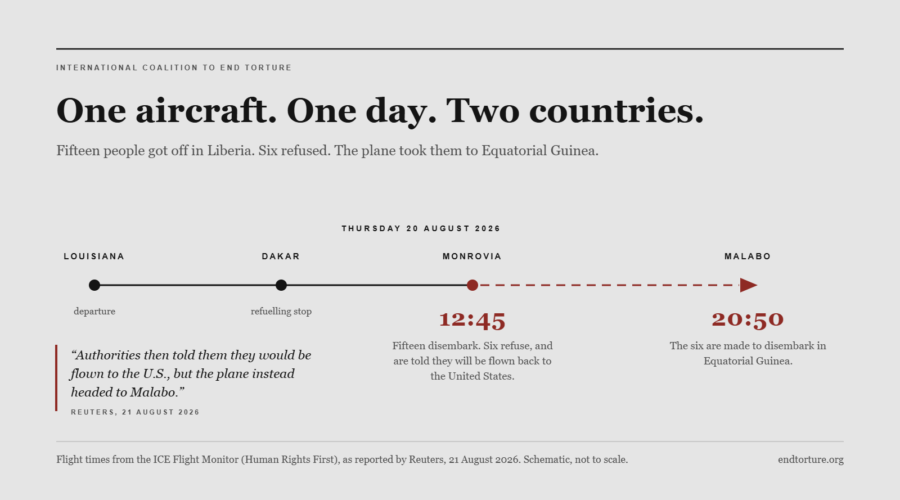
A United States removal aircraft left Louisiana, stopped at Dakar, and landed at Roberts International Airport outside Monrovia at 12:45 on Thursday 20 August 2026. Fifteen people got off. The rest refused, saying Liberia was not their country and that they would face danger there. They were told they would be flown back to the United States. At 20:50 the same aircraft landed at Malabo, in Equatorial Guinea, and they were made to get off there.
The flight log
The times above are not from an account given afterwards. They come from the ICE Flight Monitor maintained by Human Rights First and were reported by Reuters. The aircraft was on the ground at Monrovia for a matter of hours before it departed for a different continent’s worth of legal circumstances.
Liberia had announced on the Tuesday that it had agreed to receive people removed from the United States, and that the first group of twenty would arrive on the Thursday. A Liberian official, speaking anonymously, told Reuters that only fifteen got off.
Who refused, and what they said
Reuters, publishing on 21 August, reported “at least five”: three Cuban men, one Brazilian man and one Cameroonian woman. Its sourcing was three people familiar with the incident, one of them a Honduran man on the flight.
The Associated Press, publishing on 24 August from Dakar, reported six: four Cuban men, a Brazilian man and a Cameroonian woman. Its sourcing was a person on the plane and a lawyer in contact with the six.
The Coalition treats six as the better figure. Reuters wrote “at least five” and did not claim a closed count. The Associated Press published three days later with an additional source and named one more Cuban man. The two reports are not in conflict.
One arithmetic point remains open and the Coalition records it rather than smoothing it over. Liberia expected twenty. A Liberian official said fifteen disembarked. The Associated Press says six refused. Fifteen and six make twenty-one. Either the manifest was larger than announced or one of the two figures is approximate. Nothing published so far settles which.
The Honduran man who spoke to both outlets, anonymously and out of fear of reprisals, described what the refusal looked like. The group said Liberia was “not their country” and that they would face danger there. They were then separated from the others. He said the remaining passengers got off in Liberia because they feared officers would force them.
What they were told
This is the part of the account that matters most, and both outlets carry it.
Reuters, 21 August 2026. “Authorities then told them they would be flown to the U.S., but the plane instead headed to Malabo, in Equatorial Guinea, where the five were forced to disembark against their will, two of the sources said.”
Meredyth Yoon, litigation director, Asian Americans Advancing Justice-Atlanta, to the Associated Press. The people who resisted leaving the plane in Liberia “were told they would be returned to the United States but instead were flown to Malabo city in Equatorial Guinea”.
Neither outlet reports who gave that assurance, in what terms, or whether it reflected a plan that later changed. No court has examined it. The Coalition therefore records it as what two independent news organisations were told by separate sources, and not as an established act of deception.
What can be said without any inference at all is narrower and still considerable. A person who has been told the aircraft is returning to the United States has no reason, in that hour, to ask anything about Equatorial Guinea.
Where they are now
They were taken to a decommissioned hotel in Malabo. Reuters reported forty people detained there, a figure given by Ahmed Soliman, an Egyptian man who had arrived four months earlier. The Associated Press reported the six being held alongside around forty others, and identified the building in a photograph caption as the Bamy Hotel.
The Associated Press also reported the commercial arrangement behind it:
Associated Press, 24 August 2026. “Under an opaque $7.5 million deal with the Trump administration, Equatorial Guinea’s all-powerful president, Teodoro Obiang Nguema Mbasogo, has turned the hotel owned by his family into a prison for asylum seekers deported from the U.S.”
On conditions there, three accounts are on the record. They come from different places and the Coalition keeps them apart.
A joint statement of 9 July 2026. Five organisations published a statement titled Human Rights Coalition Raises Alarm Over Medical Neglect and Potential Infectious Disease Risk in Equatorial Guinea refugee detention centre. They are the Institute for Human Rights and Development in Africa, the Pan African Lawyers Union, EG Justice, Asian Americans Advancing Justice-Atlanta and the Global Strategic Litigation Council. It describes “inadequate medical care, prolonged arbitrary detention, severe psychological distress”, says that “individuals with serious medical conditions are being denied adequate medical care”, and objects to “the continued denial of independent monitoring and legal assistance”. It records that a person with a suspected case of Ebola had recently been brought under quarantine at the site and that those held there were given no masks, disinfectants or other basic protective supplies. At that date it counted seventeen people held, four women and thirteen men, from Angola, Jamaica, Mauritania and Ethiopia, the first having arrived on 24 November 2025.
A second joint statement of 12 August 2026. The same five organisations published Equatorial Guinea: Protect Deported Migrants and Lawyers Facing Threats and Intimidation, eight days before this flight. It states that “several deportees have been beaten, threatened at gunpoint, arbitrarily detained”, and describes arbitrary and indefinite detention and sexual harassment. It also reports “intimidation directed at lawyers seeking to visit and represent the detained individuals”. It records a complaint filed with the African Commission on Human and Peoples’ Rights in June 2026.
A lawyer in contact with the six. Meredyth Yoon told the Associated Press that some arrived in chains and in extreme distress, among them the Cameroonian woman and one of the Cuban men, who she said has a serious untreated medical condition requiring regular care. She said there is no medical staff at the hotel. She said conditions have worsened in recent months, with food sometimes withheld and guards accused of threatening, beating and choking some of the people held there.
The government of Equatorial Guinea did not respond to requests for comment from either outlet.
The counts in these sources move, and the Coalition does not reconcile them. The July statement counted seventeen. The August statement counted about twenty-five remaining of about fifty sent since November 2025. Reuters was told forty on 21 August. Third Country Deportation Watch, a tracker managed by Refugees International and Human Rights First, recorded fifty-three people sent to Equatorial Guinea between November 2025 and July 2026, from eleven African countries and from Georgia, Jamaica, Brazil and Cuba.
What happened on 5 September
On Saturday 5 September 2026, sixteen days after the aircraft landed at Malabo, police drew firearms on people held at the hotel. Reuters obtained video of it and published on 8 September. A still from that video shows an officer pointing a firearm at a man inside the hotel.
Reuters reported that the incident began when one of the group brought from Liberia, a Cuban man, approached officers to ask for the return of his confiscated mobile telephone so that he could contact his relatives and a lawyer. The officers ignored him. Another man held there, Ahmed Soliman, began filming.
Ahmed Soliman, to Reuters. “I was rushed at by multiple officers, me and a few other people that were outside with us. That is when they started assaulting us, grabbing my neck, my shirt, trying to dig the phone out of my pocket.”
Ahmed Soliman. “They cocked their guns, took it off of safety, pointed their guns at me telling me to get on my knees, with my hands up… I had to remain in that position for 10-15 minutes while there was chaos going on in the hotel.”
Reuters reported that men wearing shirts marked “National Police” pointed what appeared to be semi-automatic assault rifles at people inside the hotel entrance, that one man appeared to be kneeling on the ground while others screamed nearby, and that the situation ended when the hotel’s director arrived. Reuters stated that it reviewed the footage but could not independently verify what preceded the confrontation. Thirty-one people were being held at the hotel at that date.
Asked about it, the Department of Homeland Security gave Reuters a position on responsibility that the Coalition records in full:
Spokesperson, Department of Homeland Security, to Reuters, 8 September 2026. “When an individual is no longer in ICE custody then ICE will no longer be responsible for them. This is common sense.”
A State Department spokesperson said the United States would “use all legal means to remove those with no right to remain in our country”. The government of Equatorial Guinea did not respond to a request for comment.
Reuters also reported that three people held there said they had been encouraged to return to their home countries despite fears of torture and other abuses, and had not been offered any alternative. Reuters stated that it could not independently verify that account, and the Coalition records it on the same terms.
What a removal normally requires
There is a question the reporting does not ask, and it is the one that makes this flight legible. The aircraft was on the ground at Monrovia at 12:45 and on the ground at Malabo seven hours and five minutes later. Removing a person from the United States does not normally happen at that speed, and the reason is paperwork.
The Deputy Director of Immigration and Customs Enforcement described the requirement to a committee of the House of Representatives:
Daniel Ragsdale, Deputy Director, Immigration and Customs Enforcement, congressional testimony. “To effectuate a removal, two important elements are required. First, the person must be subject of an administrative order, final order of removal, and a travel document issued by the individual’s home country must be in ICE’s possession.”
The Department of Homeland Security’s own Inspector General has set out what that means in practice. Foreign governments, it found, with limited exceptions require a passport or temporary travel permit before they will accept their nationals back. International standards give a government thirty days to issue one. In a review of three thousand and fifty-three people held in immigration detention, the Inspector General found that nine hundred and forty-eight of them, thirty-one per cent, could not be removed because a travel document request was still pending. Where ICE cannot obtain one within six months and has no prospect of doing so, the person must be released.
That is the ordinary timescale of a removal. Weeks, frequently months, sometimes never.
For a removal of the kind carried out on 20 August there is no such document to obtain. The government has said so itself, in a declaration filed in a federal habeas case concerning a different man facing removal to the same country:
Declaration filed by the Department of Homeland Security in Soliman v. Warden, Eastern District of California. “His acceptance by Equatorial Guinea and placement on the manifest for this charter serves as the travel document in Petitioner’s removal.”
The manifest is the travel document. Where a country has signed a standing agreement and given assurances covering everyone sent under it, there is nothing individual to obtain, nothing for the receiving state to decide about a particular person, and therefore nothing that takes time.
The ICE memorandum of 9 July 2025 confirms the absence by what it leaves out. It specifies a Notice of Removal to be served on the individual, and written confirmation from the State Department that the country has given assurances. It does not mention travel documents at all.
One point in the same court file is unresolved and the Coalition records it rather than choosing between the versions. An earlier order in that case, summarising a deportation officer’s declaration, states that travel documents for that man’s removal to Equatorial Guinea were received on 2 April 2026. The two descriptions of the same event do not sit together, and nothing published resolves them.
The agreement nobody has seen
The arrangement under which people are sent to Equatorial Guinea was signed by the Department of State on 23 October 2025. Its text has not been published. When a federal court came to decide whether a man could lawfully be removed under it, the government did not produce it.
In August 2025 Senator Jeanne Shaheen, ranking member of the Senate Committee on Foreign Relations, wrote to the Secretary of State that Congress had not received the agreements under which people were being sent to third countries. In November 2025 she wrote again, about a payment of seven and a half million dollars made to the government of Equatorial Guinea from the Migration and Refugee Assistance account in exchange for its agreeing to accept third country nationals removed from the United States.
A federal judge in Massachusetts, considering the assurances that stand in place of any decision about an individual, put the difficulty in four questions:
United States District Court for the District of Massachusetts, 25 February 2026. “nobody really knows anything about these purported ‘assurances.’ Whom do they cover? What do they cover? Why has the Government deemed them credible? How can anyone even know for certain that they exist?”
The Coalition does not say what these operations are in law. It records what the documents show, and what they show is this. A removal of the ordinary kind waits on a named person being accepted by a named country, and that wait is measured in weeks. A removal of this kind waits on nothing. That is the distance between the thirty-one per cent still held in detention for want of a document and an aircraft that changed countries between lunchtime and nightfall.
What the United States has put in writing
The Coalition does not interpret American law. It does read what the American government publishes about its own practice, and two documents are directly relevant.
The first is a memorandum of 30 March 2025 from the Secretary of Homeland Security, titled Guidance Regarding Third Country Removals. It instructs officers not to ask whether a person fears the country they are being sent to. The process begins only if the person volunteers a fear, without being asked. The memorandum characterises asking as suggestive and apt to produce unreliable claims.
The same memorandum sets out what happens if a person does volunteer a fear and meets the screening standard. Where that person had previously been before an immigration court, the government has a choice. It may move to reopen the case, or, in the memorandum’s own words, “ICE may choose to designate another country for removal.”
The second is a memorandum of 9 July 2025 from the Acting Director of Immigration and Customs Enforcement. Three of its provisions, in its own words:
ICE, 9 July 2025. “ERO will generally wait at least 24 hours following service of the Notice of Removal before effectuating removal.”
ICE, 9 July 2025. “In exigent circumstances, ERO may execute a removal order six (6) or more hours after service of the Notice of Removal as long as the alien is provided reasonable means and opportunity to speak with an attorney prior to removal.”
ICE, 9 July 2025. “If the United States has received diplomatic assurances from the country of removal that aliens removed from the United States will not be persecuted or tortured, and if the Department of State believes those assurances to be credible, the alien may be removed without the need for further procedures.”
Those are the government’s own sentences. Read together, they describe a system in which nobody is asked whether they are afraid, the destination can be exchanged for another, and where the receiving state has given assurances the process can be dispensed with entirely.
The United States signed a third country removal agreement with the government of Equatorial Guinea on 23 October 2025. It included assurances that people removed there would not be subjected to persecution or torture, and the State Department determined those assurances credible. That fact is recorded in a federal court file, where the government did not produce the agreement itself.
What courts have ordered
The Coalition records what courts have done, without arguing what the law requires. In the past year federal district judges hearing individual cases have repeatedly ordered the government to do more than its own policy provides before sending a protected person to a country that was never part of their case.
In Kumar v. Wamsley (Western District of Washington, 17 November 2025), concerning a man from India protected from return there, the court ordered at least ten days’ written notice in the person’s own language before removal to a further country, a reasonable fear interview if fear was expressed, and fifteen days after an adverse finding to seek reopening.
In Khadka v. Mullin (Eastern District of California, 20 August 2026), concerning a man from Nepal and a proposed removal to the Central African Republic, the court ordered written notice of any third country destination in a language he could understand, a minimum of ten days to raise a fear-based claim, and a minimum of fifteen days to seek reopening.
In Ansumana S. v. Blanche (District of Minnesota, 3 September 2026), concerning a man from Ivory Coast and a proposed removal to Sierra Leone, the court held that the government’s procedures “fall short of the notice and meaningful opportunity to be heard that due process demands”, and ordered the same ten and fifteen day periods.
In a case concerning a proposed removal to Equatorial Guinea itself, the Eastern District of California enjoined removal to any third country “without notice and a meaningful opportunity to be heard in reopened removal proceedings with a hearing before an Immigration Judge”. That court declined to treat the assurances given by Equatorial Guinea as a substitute, noting that the government had not produced the agreement and that evidence before it described people sent to Equatorial Guinea being subsequently returned to their countries of origin.
There is no single nationwide rule. A class-wide judgment entered in the District of Massachusetts on 25 February 2026, which declared a right to meaningful notice before third country removal and set aside the two memoranda described above, was stayed by the First Circuit on 16 March 2026, by two judges to one. That appeal was argued on 13 May 2026 and has not been decided. The Supreme Court stayed an earlier injunction in June 2025 without issuing any opinion on what process is required.
What is still being investigated
The Coalition sets out the gaps as carefully as the findings.
The Coalition does not know the outcome of the events of 5 September, whether any inquiry followed, or the present condition of the people involved. No published report states what notice, if any, these six people received about Equatorial Guinea, or whether anyone asked them about it. Nothing establishes whether they were asked about Liberia either. No court has examined this flight. No court has been asked to. The identities of five of the six are not public, and the Coalition does not seek them.
Whether any of the six held protection against return to their own countries is still being investigated by either report. Reuters wrote that third country removals have, in most cases, involved people whom American immigration judges found to be at risk of torture or other abuses at home. That is a general statement about the programme and not a finding about these six.
Why the Coalition records this
Almost everything known about people moved to third countries is known after the fact, from what they say once they arrive. This flight is different in one respect. Part of it is documented in a public flight record: an aircraft on the ground in one country at midday and in another by evening, with the same people aboard, still in the custody of the same government.
A protection against return is specific to a country. A destination that can be exchanged while the aircraft is on the ground is not. Those two things do not fit together, and the six people who refused to get off in Monrovia are the clearest illustration so far of what the gap between them looks like.
Sources
- Robbie Corey-Boulet, Migrants flown to Equatorial Guinea after resisting Liberia deportation under Trump deal, sources say, Reuters, 21 August 2026, with additional reporting by Jessica Donati and Alphonso Toweh.
- Mark Banchereau, Deported individuals resist landing in Liberia but are sent to Equatorial Guinea, Associated Press, 24 August 2026.
- Department of Homeland Security, Guidance Regarding Third Country Removals, 30 March 2025. Source: DHS, Guidance Regarding Third Country Removals, 30 March 2025 (D.V.D. ECF 43-1)
- United States Immigration and Customs Enforcement, Third Country Removals Following the Supreme Court’s Order in Department of Homeland Security v. D.V.D., 9 July 2025. Source: ICE memorandum, 9 July 2025 (D.V.D. ECF 190-1)
- Robbie Corey-Boulet, Equatorial Guinea police pull guns on migrants deported by Trump, witnesses say, Reuters, 8 September 2026, with additional reporting by Edward James Carron.
- Institute for Human Rights and Development in Africa, Pan African Lawyers Union, EG Justice, Asian Americans Advancing Justice-Atlanta and Global Strategic Litigation Council, Human Rights Coalition Raises Alarm Over Medical Neglect and Potential Infectious Disease Risk in Equatorial Guinea refugee detention centre, 9 July 2026. Also published by Asian Americans Advancing Justice-Atlanta.
- The same five organisations, Equatorial Guinea: Protect Deported Migrants and Lawyers Facing Threats and Intimidation, 12 August 2026.
- Daniel Ragsdale, Deputy Director, United States Immigration and Customs Enforcement, testimony to the Committee on Oversight and Government Reform of the House of Representatives, Recalcitrant Countries: Denying Visas to Countries That Refuse to Take Back Their Deported Nationals, 114th Congress. Source: Hearing transcript, Serial No. 114-140, 14 July 2016
- Department of Homeland Security Office of Inspector General, ICE Faces Barriers in Timely Repatriation of Detained Aliens, OIG-19-28, 11 March 2019. Source: DHS OIG, OIG-19-28 (Government Publishing Office copy)
- Declarations and orders in Soliman v. Warden, Golden State Annex Detention Facility, No. 1:26-cv-02465, United States District Court for the Eastern District of California, public docket, consulted 16 September 2026. Sources: Soliman v. Warden (E.D. Cal., order of 27 June 2026) · Soliman v. Warden, orders on GovInfo (No. 1:26-cv-02465)
- Letters from Senator Jeanne Shaheen, ranking member of the Senate Committee on Foreign Relations, to the Secretary of State, 4 August 2025 and 10 November 2025. Sources: Shaheen letter, 4 August 2025 · Shaheen letter, 10 November 2025 · Shaheen letter, 10 November 2025 (Coalition copy)
- The court orders described above are recorded in the public federal court files for the Western District of Washington, the Eastern District of California, the District of Minnesota and the District of Massachusetts, consulted 16 September 2026. Sources: Kumar v. Wamsley (W.D. Wash., 17 November 2025), ECF 13 · Khadka v. Mullin (E.D. Cal., 20 August 2026), Doc. 15 · Ansumana S. v. Blanche (D. Minn., 3 September 2026), Doc. 19 · Soliman v. Warden (E.D. Cal., 27 June 2026), Equatorial Guinea case · D.V.D. v. DHS (D. Mass., 25 February 2026)
The Coalition’s own account of the flight is at Twenty were flown to Liberia on 20 August.
The Coalition does not publish identifying numbers, detention file references or other identifiers belonging to people named in its reports, including where those identifiers appear in a public court file. Where a court has anonymised a person, the Coalition uses the name the court used. Liberia and Equatorial Guinea both carry an Alert on this site. If someone in your family was on this flight, the route for finding a person and the legal aid index are on the Resources page. The Coalition records what courts, United Nations bodies, government oversight agencies and identified news organisations have found, and identifies which of them made each finding. It does not advise on any individual case.