Commentary. This article reports what a United States court has recorded and what the government told it. It is not legal advice.
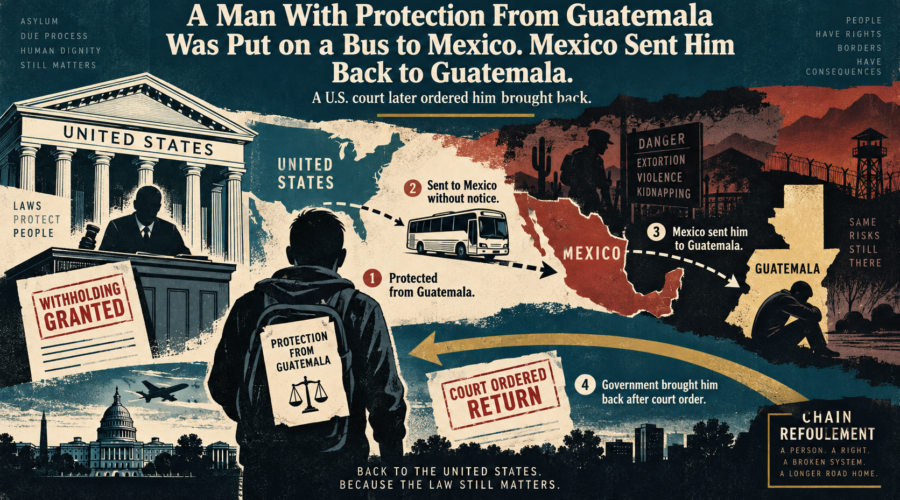
An immigration judge found that a Guatemalan man would more likely than not suffer serious harm if he were sent home, and granted him protection against removal to Guatemala. Two days later he was put on a bus to Mexico without notice. Mexico sent him to Guatemala, where he went into hiding. A United States court ordered him brought back. The government brought him back.
What the court recorded
The findings are in a memorandum and order of the United States District Court for the District of Massachusetts, signed by Judge Brian E. Murphy on 23 May 2025 in D.V.D. v. U.S. Department of Homeland Security, No. 1:25-cv-10676-BEM, since published at 784 F. Supp. 3d 401. The man is identified in the case only as O.C.G.
“Plaintiff O.C.G. has no known criminal history. After suffering multiple violent attacks, O.C.G. sought protection in the United States, where an immigration judge granted him withholding of removal from his native country, Guatemala. This means that the immigration judge found it more likely than not that O.C.G. would suffer serious harm if sent back to Guatemala. Two days later, and without any notice, O.C.G. was placed on a bus and sent to Mexico, a country where he was previously held for ransom and raped.”
And then, in a single sentence:
“As a result, O.C.G. was given up to Mexico, which then sent him back to Guatemala, where he remains in hiding today.”
This is what the Coalition records as indirect refoulement, also called chain refoulement. The protection was never withdrawn. It was routed around.
He asked about Mexico. He was told it could not happen.
The judgment of 25 February 2026 sets out what had been said in the immigration court before any of this happened. The passage below is the district court quoting its own earlier opinion, which in turn draws on the transcript of the withholding-only hearings.
“During the withholding-only proceedings, O.C.G. asked if he might be sent to Mexico—because he was afraid of being sent to Mexico—and the immigration judge told him, ‘we cannot send you back to Mexico, sir, because you’re a native of Guatemala.’ During another hearing before the immigration court, O.C.G. described in detail the violence he experienced while in Mexico. At the close of that hearing, the government’s attorney clarified with the immigration judge that, because Guatemala was the country of removal designated on O.C.G.’s order of removal, that was the only relevant country for purposes of the withholding-only proceedings, and the immigration judge agreed.
Two days after being granted withholding of removal, and with no advanced warning, O.C.G. was put on a bus and sent to Mexico.”
He raised Mexico himself, and he was told by the judge that Mexico was not a place he could be sent. The government’s own attorney then asked the judge to confirm that Guatemala was the only country the hearing was about, and the judge agreed. Two days later he was on a bus to Mexico.
The sworn statement the government withdrew
The court had already been asked once to order O.C.G. returned, and had declined, because the government had filed a declaration made under oath stating that before removal he had said he was not afraid of being sent to Mexico. O.C.G. said he was told about Mexico as it was happening and was refused his attorney. Because the accounts conflicted, the court ordered discovery instead.
The court then records that on 16 May 2025 the government “acknowledged an ‘error’ in their previous filings and statements to the Court.”
What the government said the rule was
At a hearing on 28 March 2025, government counsel described the policy the department was operating under. The court quoted that description, from the transcript, on the first page of its judgment of 25 February 2026:
“The Department of Homeland Security has adopted a policy whereby it may take people and drop them off in parts unknown, in so-called ‘third countries’ and, ‘as long as the Department doesn’t already know that there’s someone standing there waiting to shoot . . . that’s fine.’”
The court answered in four words.
“It is not fine, nor is it legal.”
What was ordered, and what happened next
On 23 May 2025 the court ordered the government “to take all immediate steps, including coordinating with Plaintiffs’ counsel, to facilitate the return of O.C.G. to the United States,” and to report back within five days.
The government did not resist the order. Five days later it filed a two-page status report saying that a parole packet had been approved and that ICE Air was working to bring him back on a return leg.
He came back. The court says so in its judgment of 25 February 2026, in the passage where it recounts the history of the case. It had, it wrote, “affirmed its previous conclusion that O.C.G.’s removal lacked due process and, this time, ordered his return, id. at 410–12, which the Government later facilitated, Dkt. 143.” The document number at the end of that sentence is the status report described in the paragraph above.
A footnote in the same judgment records that his lawyers had told the court, “now that [O.C.G.] has been returned [to the United States] and released,” a further claim in the case applied to him as well. The square brackets are the court’s.
Where it stands
The return order is one ruling among several in the same case, and they have had different fates. The classwide injunction of 18 April 2025 was stayed by the Supreme Court on 23 June 2025. The judgment of 25 February 2026, which set the third-country removal policy aside, was stayed by the Court of Appeals for the First Circuit on 16 March 2026 and is on appeal as No. 26-1212. Nothing in this article should be read as a statement of what a court would order today.
The record of what happened to O.C.G., however, is a finding in a signed order, and an appeal does not unmake it.
Sources
Memorandum and Order, Document 132, 14 pages, 23 May 2025, published as 784 F. Supp. 3d 401 (D. Mass. 2025): CourtListener.
Defendants’ Status Report Regarding O.C.G., Document 143, 2 pages, 28 May 2025: CourtListener.
Memorandum and Order on summary judgment, Document 241, 81 pages, 25 February 2026: CourtListener.
The entry for this order in the Coalition’s register is here. The provisions that govern removal to a third country, and the treaty texts that reach the second country, are set out on The laws that protect people from torture. The rules that require the country of removal to be identified in the hearing, and what two courts of appeals said about them in 1998 and 1999, are set out in The rules say the country must be named. Sources: Register entry: D.V.D. v. DHS (return of O.C.G.) · The laws that protect people from torture · The rules say the country must be named