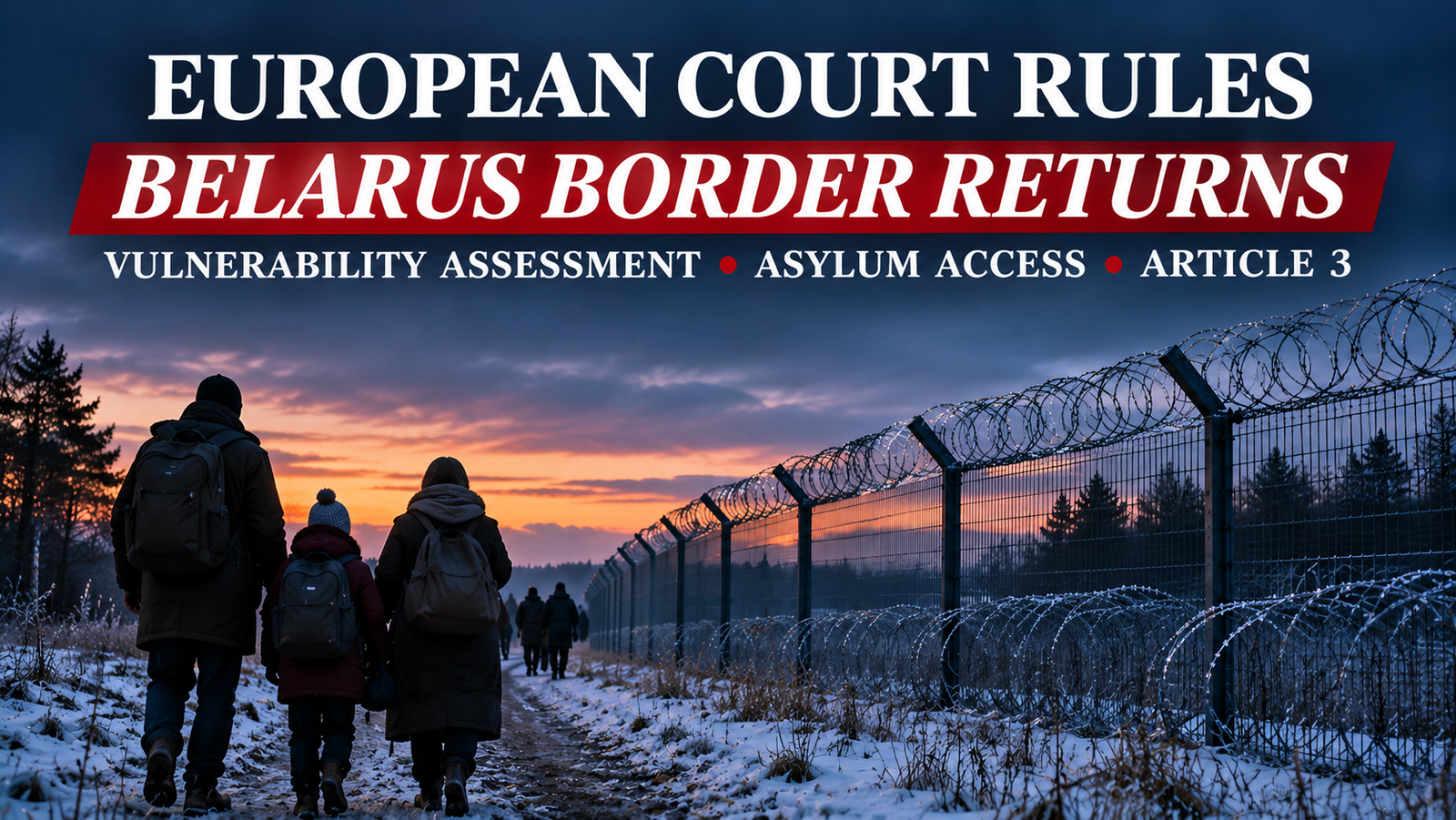
The Grand Chamber of the European Court of Human Rights delivered its three judgments on the summary returns at the Belarusian border on November 24, 2026. It held that a state faced with migration organized by another state may close its border and send people back, and that it is not required to ask whether they will reach an asylum procedure on the other side. It also held that before any such return the authorities must identify the people who are evidently at risk, and that Poland and Latvia failed to do so.
The Court found a violation of Article 3 of the Convention, the prohibition of torture and of inhuman or degrading treatment, against Poland in respect of one applicant who was sent back to Belarus on October 20, 2021, and against Latvia in respect of the applicant children and the family members on whom they depended. Against Lithuania it found no violation of Article 3 on the returns, by eleven votes to six, and it found violations of Article 5, the right to liberty, in respect of the detention that followed.
The three cases are A.R. and Others v. Poland, application number 42120/21, H.M.M. and Others v. Latvia, number 42165/21, and C.O.C.G. and Others v. Lithuania, number 17764/22. The Coalition recorded the cases, the complaints and the interim measures when the Court announced the delivery date on November 3, 2026. The applicants are Afghan, Iraqi Kurdish and Cuban nationals, and the events run from August 2021 to April 2022.
What the Court decided, state by state
| State | Article 3, on the return to Belarus | Other findings | Declared inadmissible |
|---|---|---|---|
| Poland A.R. and Others 42120/21 |
Violation, unanimously, in respect of the first applicant, on account of his removal on October 20, 2021. | Violation of Article 34, unanimously. The press release attributes the finding to what happened with the applicants’ lawyers. No Article 5 finding is reported. | Article 3 as to ill treatment by Polish officers; Articles 2 and 3 as to material and sanitary conditions in the camp; Article 13 taken with Articles 2 and 3. |
| Latvia H.M.M. and Others 42165/21 |
Violation, unanimously, in respect of the applicant children and their accompanying family members, for removals on August 11, August 14 and September 10, 2021. No violation, unanimously, in respect of the adult applicants numbered 14, 22 and 24. | Violation of Article 3, unanimously, for the conditions experienced in the border zone. No violation of Article 13 taken with Article 3 on those conditions. Article 5, paragraphs 1 and 4: violation in respect of the applicant children, held at the Daugavpils center; no violation in respect of the adults. | Article 3 as to ill treatment by Latvian officials; Article 13 taken with Article 3 as to remedies for that ill treatment. |
| Lithuania C.O.C.G. and Others 17764/22 |
No violation, by eleven votes to six. | Violations of Article 5, paragraphs 1, 2 and 4, unanimously, concerning detention from April 15 to October 18, 2022, the information given about its reasons, and its review by a court. No violation of Article 34, by eleven votes to six. | Article 13 taken with Article 3 on the removal; Article 3 as to ill treatment by Lithuanian border guards; Article 13 taken with Article 3 as to remedies for that ill treatment. |
On Article 4 of Protocol No. 4, the prohibition of collective expulsion, which all three sets of applicants had invoked, the Court did not make a separate finding against any state. The press release records that the requirements of that provision “did not, in the present and specific context, go beyond those of Article 3 of the Convention,” and that the Court did not consider it necessary to examine the related complaints under Article 13.
Under Article 41 the Court awarded 20,000 euros to the first applicant and 5,000 euros to the second in the Polish case, together with 3,137.01 euros in costs; a series of awards of 20,000, 15,000 and 7,500 euros to individual applicants and family groups in the Latvian case, together with 15,000 euros in costs; and 15,000 euros to each applicant in the Lithuanian case, together with 1,800 euros in costs.
The test the Court set
The Court’s starting point was the conduct of Belarus. The press release describes a situation in which a state “had encouraged, facilitated, or forced the movement of migrants across its borders with the intention of destabilising the respondent States or the wider region,” and it reports the Court’s view that such conduct “represented a deliberate threat to the State.” The Registry’s questions and answers document records that the Court refers to this conduct as “instrumentalisation of migration.”
Against that background the Court did not hold that returns to Belarus were permitted without more, and it did not hold that they were forbidden. It set a duty of identification. The press release states the obligation in these terms:
“the national authorities had an obligation to detect those individuals who would be particularly at risk of suffering or enduring ill-treatment.”
European Court of Human Rights, press release ECHR 297 (2026), November 24, 2026, in the section on the approach in cases of instrumentalisation of migration.Two categories of people fall within that duty. The first is described as those “who presented evident personal vulnerabilities (for example, owing to age, ill health or disability).” The second is those “with a specific basis for claiming that removal to the instrumentalising State would evidently expose them to a real and immediate threat to life.” For the second category the press release records that “the burden of proof would be on the person concerned to provide evidence which, on the face of it, might be reasonably expected in the circumstances.”
Outside those two categories, the press release records the consequence plainly: “It followed that, in a situation of instrumentalised migration, the removal of a foreign national to the instrumentalising State would not, as such, constitute a violation of Article 3 of the Convention.”
What the Court did not require
One sentence in the Registry’s account carries as much weight as the findings. The press release states that it was “not necessary for the authorities of the State in question to carry out an assessment of whether individuals would have access to an adequate asylum procedure” in the state from which they had come.
That is a narrower inquiry than the one the Coalition has recorded elsewhere. The Special Rapporteur on Torture has taken the position that an assessment must cover the whole chain of transfer, which includes what the receiving state will do next. On the Registry’s account, the Grand Chamber has held that in this specific context, where the receiving state is the state that organized the movement, the returning state need not examine whether an asylum procedure is available there. The Court’s reasons for confining the point to that context are in the judgments, which have not been read.
How the ruling was received
The ruling has been read as a victory by one of the respondent governments and as a boundary setting exercise by one of the intervening organizations, and the Coalition records both.
Notes from Poland reports that Poland’s Deputy Interior Minister, Maciej Duszczyk, called the ruling “very important and favourable for us” and said that it “effectively endorsed Poland’s policies.” The same report quotes the Helsinki Foundation for Human Rights, which intervened in the Polish case, as saying that in the Court’s view, “when migration is instrumentalised, states are not obliged to assess whether people being returned to the state instrumentalising migration will have access to an adequate asylum procedure there.”
Both readings can be held at once, and that is the difficulty of the ruling rather than a defect in the reporting of it. Poland lost on the return of the applicant it removed in the face of an interim measure, and lost again under Article 34. It also obtained a statement of principle that permits border closures and returns in this context without an assessment of asylum access.
What this does not decide
These three cases concern returns across a land border to the state the applicants had just come from, and that state is the state the Court found to have organized their movement. They are not cases about transferring a person to a country chosen by the removing state and unconnected to the person’s journey, which is the subject of most of the record on this site.
Four distinctions follow, and the Coalition states them because the ruling will be cited in arguments where they matter.
- Return to the instrumentalising state is not transfer to a third country. The Registry’s account confines the reasoning to the situation in which the receiving state is the one that organized the movement. Nothing in it addresses a transfer to a state with no connection to the person, under an arrangement between governments.
- Harm at the destination is not harm at the end of the route. The applicants in the Polish case also complained that return to Belarus exposed them to onward return to Afghanistan. The press release does not record a separate finding on that complaint, and it is a different claim from the claim that the destination itself is unsafe.
- A finding of no violation is not a finding that the conduct was lawful in every respect. Lithuania was found to have violated Article 5 three times over in the same case in which it was found not to have violated Article 3.
- An inadmissibility decision is not a merits ruling. The allegations of ill treatment by Polish officers, Latvian officials and Lithuanian border guards were declared inadmissible. That is not a determination that the treatment did not occur.
What is not known
- The judgments themselves. The full texts were not retrievable when this was written. Every finding above is traced to the Registrar’s press release and the Registry’s questions and answers document, not to the operative paragraphs. The press release states that it does not bind the Court.
- The reasoning of the six judges who dissented on Lithuania. The press release lists a joint partly dissenting opinion by Judges Ktistakis, Paczolay, Felici, Krenc, Kovatcheva and Adamska-Gallant in the Lithuanian case, a partly dissenting opinion and a statement of partial dissent in the Polish case, and a concurring opinion by Judge Elósegui in the Latvian case. None of those texts has been read.
- The full scope of the Article 34 finding against Poland. The press release attributes the violation to what happened with the applicants’ lawyers. The applicants had also complained under Article 34 that Poland removed one of them in the face of the Court’s interim measure of September 27, 2021. Whether the finding covers both matters is not clear from the press release.
- How the duty to detect is to be discharged. The Registry’s account states that authorities must identify people in the two categories before removal. It does not state what procedure satisfies the duty, how it operates at a closed border, or what record a state must keep.
- What becomes of the other pending cases. When it heard these three the Court said they were among over thirty such cases pending against the three states. The press release does not say what happens to those.
- The effect on Poland’s current law. All three cases concern events between August 2021 and April 2022. They predate the power, in force since March 27, 2025, under which Poland has suspended the right to apply for international protection at the Belarusian border. That power is recorded on the Coalition’s page on Poland, and the press release does not address it.
- Whether the Committee against Torture will take a different view. Poland’s eighth periodic report, which gives the government’s own account of this period, is still awaiting a session.
Sources
European Court of Human Rights, press release ECHR 297 (2026), November 24, 2026, Grand Chamber cases concerning instrumentalisation of migration; the Court’s page on the delivered judgments; and the Registry’s questions and answers on the three rulings, which states that it is a tool for the press and does not bind the Court. The full judgments are to be published in the Court’s HUDOC database, which returned no document for these applications when this was written.
For the government and non-governmental reaction: Daniel Tilles, “Poland, Lithuania and Latvia violated rights of migrants sent back to Belarus, finds European court”, Notes from Poland, November 24, 2026.
For the cases, the complaints and the interim measures as they stood before delivery, see the Coalition’s earlier report, which cites the Court’s press releases of February 12, 2025 on the hearings and Poland’s eighth periodic report to the Committee against Torture, CAT/C/POL/8.
Related on this site
- The European Court Will Rule on 24 November on the Summary Returns at the Belarusian Border, the Coalition’s report of the cases before delivery.
- Poland, and the list of states engaging in refoulement.
- Cuba, the country of origin of the applicants in the Lithuanian case, and the other countries named in protection orders.
- Refoulement and the laws that protect people from torture.
- What each state accepted under the Convention against Torture.
- Special Rapporteur on Torture: Assessments Must Cover the Whole Chain of Transfer.
- Constructive Refoulement: When a Return Recorded as Voluntary Is Not a Free Choice.
- The Rules Say the Country Must Be Named, and what Nasrallah v. Barr permits and what it does not, for the position in the United States.
- A Commons Committee Rejected Plans to Disapply the Human Rights Act in Removal Cases.
- What the courts have held on diplomatic assurances, and the register of court and administrative decisions.
Nothing on this page is legal advice. The Coalition does not represent anyone and cannot take an individual case.