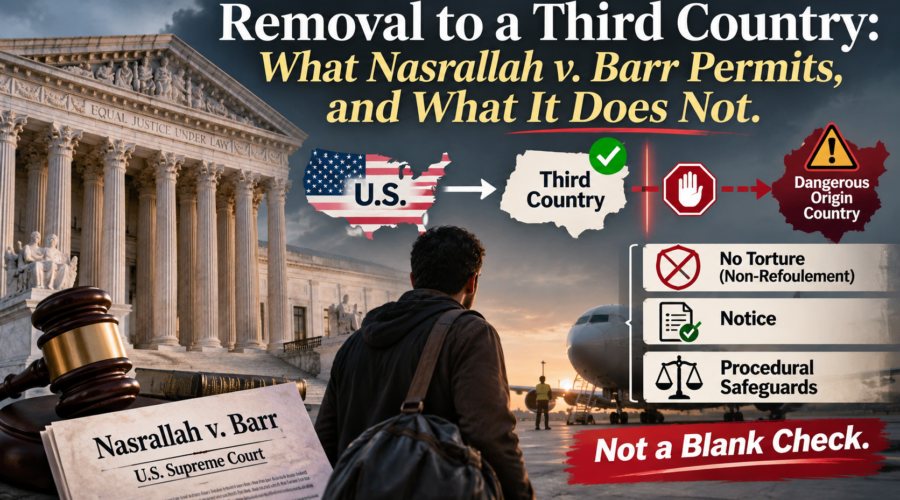
Commentary. This is the Coalition’s argued reading of the law and the record, and the second of seven parts. The court opinions, orders, briefs, guidance and statutes it relies on are linked where they are discussed and listed at the end, and every quotation is taken from those documents. It is not advice.
An investigative legal series · Part 2 of 7
Third-Country Deportations: The Law, the Loopholes, and the Risk of Torture
The series follows the Coalition’s commentary of 26 October 2026, Third-Country Removal Is a Pretext for Refoulement. Each part can be read on its own.
- Part 1A Criminal Conviction Does Not End Protection Against Torture
- Part 2Removal to a Third Country: What Nasrallah v. Barr Permits, and What It Does Not (this article)
- Part 3Out of Public View: The Detainee Locator Policy and Access to Counsel
- Part 4The Country That Was Supposed to Be Safe Sent Them Back
- Part 5Payments to Other Governments, and the Safeguards That Should Come With Them
- Part 6Iranian Nationals and the Risk of Return to Torture
- Part 7The Legal Obligations That Continue After Deportation
How a lawful alternative to removal into torture became the center of a dispute over diplomatic assurances, notice, and the risk of onward refoulement.
The Supreme Court has recognized that a person who cannot lawfully be sent to one country, because torture is likely there, may still be removed to another. Nasrallah v. Barr says so in terms. It does not say that any country willing to take the person is safe, or that the government may dispense with procedures for finding out.
The dispute now before the Supreme Court is narrower and more concrete. In September 2026 the First Circuit held that the government’s procedures for removals to third countries did not give effective notice or a meaningful opportunity to raise a fear of the new country. On 29 September the Supreme Court stayed the judgment the First Circuit had affirmed and agreed to review the case; argument is set for 9 December 2026. This part sets the competing positions side by side, from the government’s brief of 23 October 2026, the guidance issued by the Department of Homeland Security and by ICE, the First Circuit’s opinion, and the record of people sent on from the countries they were taken to.
What the Supreme Court decided in Nasrallah, and what it did not
Part 1 of this series sets out the case in detail. Nidal Khalid Nasrallah, a citizen of Lebanon, was ordered removed after a criminal conviction; an immigration judge granted protection under the Convention Against Torture, and the Board of Immigration Appeals reversed. The question was whether a court of appeals could review the facts behind the Board’s ruling. The Court held that it could, deferentially, because a CAT order is distinct from a final order of removal.
In explaining why, the Court described what a CAT order does. It “means only that, notwithstanding the order of removal, the noncitizen may not be removed to the designated country of removal, at least until conditions change in that country. But the noncitizen still ‘may be removed at any time to another country where he or she is not likely to be tortured.’” The second sentence quotes the regulations, 8 C.F.R. § 1208.17(b)(2), and the rule it states comes from them; it describes the alternative as a country where torture is not likely. The government’s brief makes the same point through Johnson v. Guzman Chavez, 594 U.S. 523, 536 (2021), which it cites for the proposition that withholding and CAT protection “affect only where, not whether, an alien may be removed.”
Nasrallah did not consider the procedures DHS adopted in 2025. It did not decide how a person must be told of a newly chosen country, whether diplomatic assurances can take the place of an individual screening, or what is required when the country chosen may send the person on to the one a judge ruled out. Those questions arise under other statutes, the regulations and the Constitution. Nasrallah settles the premise that removal elsewhere is possible. It does not settle the procedures.
The removal-country statute: authority, with conditions
The statute that governs where a person may be sent is 8 U.S.C. § 1231(b). For most people ordered removed from inside the United States, it sets a sequence. The person may designate a country, and the government “shall remove the alien to the country the alien so designates,” although the Attorney General “may disregard” the designation if the person does not designate a country promptly, the country does not answer within 30 days or will not accept the person, or removal there would be prejudicial to the United States. Next comes a country of which the person is a subject, national or citizen. Then come six options tied to the person’s history, among them the country from which the person was admitted, a country of earlier residence, and the country of birth. Only if removal to each of those is “impracticable, inadvisable, or impossible” may the government send the person to “another country whose government will accept the alien into that country.”
In Jama v. Immigration and Customs Enforcement (the United States Reports), the Supreme Court read that sequence closely. “In all of subparagraph (E),” it held, “an acceptance requirement appears only in the terminal clause (vii),” so the government may remove a person to a country listed in clauses (i) to (vi) without that country’s advance consent. Acceptance matters elsewhere: the Court noted that “[e]ffects are attached to nonacceptance throughout the rest of paragraph (2).” It also relied on “our customary policy of deference to the President in matters of foreign affairs.” The Court did not treat acceptance as the measure of safety. It explained that an acceptance requirement was unnecessary to protect people from mistreatment, because “[i]f aliens would face persecution or other mistreatment in the country designated under § 1231(b)(2), they have a number of available remedies,” among them withholding of removal and “relief under an international agreement prohibiting torture.”
The regulations add 8 C.F.R. § 1208.16(f): nothing in the withholding and deferral rules “shall prevent the Service from removing an alien to a third country other than the country to which removal has been withheld or deferred.” The provision preserves the possibility of a lawful removal elsewhere. It does not certify that any particular destination is safe.
The Convention imposes a separate limit
Article 3 of the Convention Against Torture forbids returning a person to another State “where there are substantial grounds for believing that he would be in danger of being subjected to torture.” The United States understood that phrase, when it ratified the Convention, to mean “if it is more likely than not that he would be tortured,” and gives effect to article 3 through section 2242 of the Foreign Affairs Reform and Restructuring Act of 1998 and the regulations on withholding and deferral, which Part 1 describes.
Protection under those rules is country-specific. A person granted deferral of removal to Iran, for example, may remain under a final order of removal, and the government may look for another country. The deferral order means that the United States may not send the person to Iran while it stands. A proposal to send the person elsewhere raises a further question: whether the person would be tortured in the new country, or would be sent on from there to Iran.
The regulations contain their own mechanism for diplomatic assurances. The Secretary of State may forward assurances obtained “from the government of a specific country that an alien would not be tortured there if the alien were removed to that country.” If the Attorney General finds them sufficiently reliable, the person’s claim for protection under the Convention “shall not be considered further by an immigration judge, the Board of Immigration Appeals, or an asylum officer,” and deferral may be terminated on that basis. 8 C.F.R. § 1208.18(c); 8 C.F.R. § 1208.17(f). The First Circuit acknowledged that these provisions contemplate that “individualized diplomatic assurances obtained by the Secretary of State can in some circumstances substitute for an administrative order providing the noncitizen with FARRA/CAT protection,” while observing that “nothing in that regime contemplates the substitution of blanket diplomatic assurances for the detailed and individualized procedures governing such a claim.” The government reads the same regulations differently: “nothing in the regulations requires a country’s assurance to be alien-specific.” The live dispute is therefore not whether assurances may ever replace an individual procedure, but whether a general assurance covering everyone sent to a country may do so.
The question of onward removal becomes pressing when the new country has no working asylum system, grants only a short stay, or has sent people on before. The UN Committee against Torture treats a chain of transfers that ends in torture as a breach of article 3. In its General Comment No. 4, it states that a person at risk “should never be deported to another State from which the person may subsequently face deportation to a third State in which there are substantial grounds for believing that the person would be in danger of being subjected to torture.” The Committee’s general comments do not bind the United States, and in some respects they go further than American law, which permits removal to a third country and applies the more-likely-than-not standard; the withholding and deferral regulations do not address onward removal in terms. Whether a particular transfer breaches United States law depends on the statutes, the regulations, the evidence and the procedures the courts require. A different first destination does not, without more, resolve the risk.
The February 2025 directive
According to the First Circuit’s opinion, a directive ICE issued on 18 February 2025 instructed officers to “review for removal” the cases of people who had been granted protection from removal to one or more countries on a fear-based claim, and to “determine the viability of removal to a third country and accordingly whether the alien should be re-detained.” The government describes the directive more broadly, as reaching people who had been ordered removed “but whose removal was impeded,” and points to “the Administration’s significant gains with regard to previously recalcitrant countries.” The Congressional Research Service records that the guidance also reached people previously released from ICE custody because there was “no significant likelihood of removal in the reasonably foreseeable future” to the country originally designated.
The class in the litigation is defined by the kind of removal, not by a prior grant of protection. It covers people with final orders whom DHS “has deported or will deport on or after February 18, 2025,” to a country not previously designated and not identified in writing in their earlier proceedings, and its named members differ, the First Circuit noted, in “whether they have been awarded relief based on a fear-based claim.” For those who already hold protection, the directive raises a particular concern, because they have won a finding that removal to a particular country would breach the protection standards. The government did not act unlawfully merely by looking for another destination; the statute allows one in defined circumstances. The dispute is about what happens once a country is chosen, and in particular whether the person is told in time and given a real chance to show that the new country is dangerous.
The March 2025 guidance: diplomatic assurances in place of further procedures
On 30 March 2025, two days after the district court in Massachusetts entered a temporary restraining order, Secretary of Homeland Security Kristi Noem issued a memorandum titled Guidance Regarding Third Country Removals, filed in the case as Document 43-1. The memorandum describes itself as clarifying DHS policy, and notes that DHS “has used similar processes before, including with respect to Title 42 expulsions and the Migrant Protection Protocols.” Its central provision concerns diplomatic assurances. Before removal to a country not previously designated, DHS “must determine whether that country has provided diplomatic assurances that aliens removed from the United States will not be persecuted or tortured. If the United States has received such assurances, and if the Department of State believes those assurances to be credible, the alien may be removed without the need for further procedures.”
Where there are no such assurances, or the State Department does not find them credible, DHS informs the person of the destination, but “Immigration officers will not affirmatively ask whether the alien is afraid of being removed to that country.” The memorandum gives two reasons. The first is DHS’s determination in mid-2024, in its “Securing the Border” rulemaking, “that such questioning may be suggestive and that asking them leads to false claims.” The second is that, because an allegation that a foreign government will torture or allow persecution is a serious one, “[i]t is not unreasonable for an alien in that circumstance to be expected to affirmatively express a fear of persecution or torture.” A person who states a fear is referred to U.S. Citizenship and Immigration Services, which “will generally screen the alien within 24 hours of referral,” applying the more-likely-than-not standard. A person who meets it is referred to the Immigration Court if not previously in proceedings there; otherwise ICE may move to reopen, or “may choose to designate another country for removal.” The procedures apply only to people with no ongoing proceeding in which to raise a protection claim.
The government’s brief explains the policy by its results. It says that people who could not be returned home, “many of them” with “serious criminal histories,” were often released before the guidance; that finding a willing country “often entails delicate diplomatic negotiations that would be undermined by lengthy delays”; and, citing the Secretary of State, that the district court’s earlier injunction would “cause significant and irreparable harm to U.S. foreign policy.” The class answers that the arrangement places the burden of recognizing and voicing a danger on a detained person who may know little about the country named, may have no lawyer, and may have no way to gather evidence within a day. The First Circuit did not rule on that objection as a constitutional matter. It decided the case on statutory and regulatory grounds and said that it did “not address DHS’s argument that the Guidance satisfies due process requirements because blanket diplomatic assurances can substitute for individualized process as a constitutional matter.” If the Supreme Court reaches the merits, which it will do only if it holds that the district court had jurisdiction, the question will be whether a general assurance accepted by officials can take the place of an individual procedure where the risk is irreversible.
Twenty-four hours, six hours, or no further screening
ICE restated the procedures in a memorandum to all employees on 9 July 2025, after the Supreme Court stayed the district court’s preliminary injunction. Where the State Department has found assurances credible, “the alien may be removed without the need for further procedures.” Otherwise an officer serves a Notice of Removal naming the country, read to the person in a language he or she understands; “ERO will not affirmatively ask whether the alien is afraid of being removed to the country of removal”; and “ERO will generally wait at least 24 hours following service of the Notice of Removal before effectuating removal. In exigent circumstances, ERO may execute a removal order six (6) or more hours after service of the Notice of Removal as long as the alien is provided reasonable means and opportunity to speak with an attorney prior to removal.” A removal on less than 24 hours’ notice “must be approved by the DHS General Counsel, or the Principal Legal Advisor where the DHS General Counsel is not available.” The memorandum adds that the Supreme Court’s stay “does not alter any decisions issued by any other courts as to individual aliens regarding the process that must be provided before removing that alien to a third country.”
A person told that he or she will be sent to the Central African Republic, Eswatini or Equatorial Guinea may know nothing about its courts, its detention practices, its medical care, its immigration rules or its practice on onward removal. A lawyer trying to find out needs country reports, diplomatic records, medical evidence and information about how the country has treated people sent there before. A short notice period is not, without more, a breach of due process; that is what the courts are deciding. The worth of notice lies in whether it allows a realistic chance to understand and contest the destination.
D.V.D. in the First Circuit
The challenge to these procedures is D.V.D. v. U.S. Department of Homeland Security, a class action filed in the District of Massachusetts on 23 March 2025. The class members accept that they are under final orders of removal and may be removed to lawful destinations. They argued that DHS may not carry out removals to newly chosen countries without effective notice and a meaningful opportunity to raise fear-based objections to those countries.
On 25 February 2026 the district court entered final judgment (the Coalition’s copy). As the First Circuit summarized it, the judgment declared that the law requires DHS “to provide every class member with effective notice and a meaningful opportunity to raise any fear-based claim regarding their removal to a third country,” and it “set aside the Guidance as unlawful under the APA insofar as it authorizes removals that do not comply with these requirements.” On 16 March 2026 the First Circuit granted the government a stay pending appeal.
On 18 September 2026 the First Circuit largely affirmed. It held that the named plaintiffs lacked standing to pursue their “sequencing” claim and vacated the two declarations requiring DHS first to seek removal to countries the class members designated or of which they are nationals. “Otherwise, we affirm the judgment.” It held that 8 U.S.C. § 1231(b)(3) requires notice and an opportunity to raise statutory withholding claims before a third-country removal, and that “the FARRA/CAT and its implementing regulations require that noncitizens be provided with effective notice and a meaningful opportunity to present a fear-of-torture claim before DHS may remove them to a third country.” The court read the law that way to avoid a serious constitutional problem, and it expressly did “not reach the question whether the Guidance also violates the Fifth Amendment’s Due Process Clause.” Its reasoning turned on a practical point: “an individual’s right to avoid removal to a country where one is likely to be tortured means little if one is not given prior notice of an intended third-country removal to that country and a meaningful opportunity to assert their fear of torture if removed to that location.” On 23 September 2026 the court dissolved its stay.
The Supreme Court’s stay of 29 September 2026
On 29 September 2026 the Supreme Court granted the government’s application: “The February 25, 2026 order and judgment of the United States District Court for the District of Massachusetts, case No. 1:25-cv-10676, are stayed.” It treated the application as a petition for certiorari, granted it, and directed argument on four questions: whether the district court had jurisdiction; whether it had authority to enter classwide declaratory relief and APA vacatur under 8 U.S.C. § 1252(f)(1); whether the guidance “is unlawful under 8 U. S. C. §1231(b), the Due Process Clause, or FARRA/CAT and its implementing regulations”; and such other questions as the government considered appropriate. Justices Sotomayor, Kagan and Jackson would have denied the stay. Argument is set for 9 December 2026.
The government’s brief counts the order as the third time the Court has stayed lower-court efforts to halt the policy. On 23 June 2025 the Court had stayed the district court’s preliminary injunction, and on 3 July 2025 it clarified that the stay barred the district court from enforcing that injunction. The order of 29 September gives no reasons. It provides that the stay “shall terminate upon the sending down of the judgment of this Court,” so the guidance remains in operation until then. The stay is not a decision on the merits. Nor can the First Circuit’s conclusions be described as giving relief while the judgment they affirmed is stayed. The legality of the policy is unresolved. The Coalition reported the stay when it was entered, and the register entry records the order.
The government’s position
The government’s brief, filed on 23 October 2026, makes three principal arguments. First, it contends that the district court lacked jurisdiction: 8 U.S.C. § 1252(g) bars “any cause or claim” “arising from the decision or action” to “execute removal orders against any alien,” § 1252(b)(9) channels questions arising from removal into petitions for review, and section 2242(d) of the 1998 Act and § 1252(a)(4) preclude district-court jurisdiction over claims “under” the Convention. Second, it contends that § 1252(f)(1) bars classwide relief, a bar that in its view “covers coercive declaratory judgments” as well as universal vacatur. Third, it contends that the guidance is lawful, because “neither Section 1231 nor FARRA (nor their implementing regulations) sets forth specific procedures for third-country removals at all. Indeed, filling that gap was the reason for the policy.” It answers the First Circuit’s reliance on constitutional avoidance with a sentence from Jennings v. Rodriguez: “Spotting a constitutional issue does not give a court the authority to rewrite a statute as it pleases.”
On due process, the brief argues that the guidance “ensures that any alien will either be sent to a country where the United States has secured a credible assurance that no alien will be tortured or persecuted, or will be given actual notice and an opportunity for a prompt review as to any affirmative fear of removal,” in a field involving immigration and foreign affairs, where, the brief says, “the Executive is entitled to the greatest deference.” It compares the procedures to expedited removal, which the Court upheld in Department of Homeland Security v. Thuraissigiam, and argues that, having had a prior opportunity to raise withholding or Convention claims, class members “are thus familiar with those modes of protection.” Invoking the so-called entry fiction, it argues that class members who entered without inspection should receive no greater constitutional protection than people stopped at the border. On assurances, it relies on Munaf v. Geren, 553 U.S. 674 (2008), and Kiyemba v. Obama, 561 F.3d 509 (D.C. Cir. 2009): “When the Executive credits such an assurance, that decision is conclusive,” and courts are no better placed to question an assurance “when it is categorical rather than individualized.”
The United States has a legitimate interest in carrying out final orders of removal, and its authority to negotiate arrangements with other governments is well established. A person protected against one country is not entitled to remain in the United States indefinitely if a lawful alternative exists. The legal question is whether the government’s procedures protect the distinct statutory and constitutional interests that a newly chosen destination engages. The class says that effective notice and a meaningful opportunity to state a fear are what make the protections Congress and the agencies created work in practice. The government says its procedures meet the law and that the lower courts exceeded their authority in requiring more. The Supreme Court will decide that dispute within the questions it has taken.
After the third country takes custody
Even where the United States lawfully chooses another destination, a further danger remains. A country that takes a person may send him or her on to the country a judge ruled out. That is onward, or chain, refoulement, and it goes to the reliability of the assurances and the foreseeability of the onward removal.
CBS News’ 60 Minutes examined that danger in a broadcast on 25 October 2026. It obtained the names of all 63 people on a removal flight that left Texas on 30 July 2026 and stopped in Sierra Leone, the Central African Republic and Ghana. “Seventeen of the 19 people we reached who were sent to Ghana told us the same thing: Ghana quickly transported them, against their will, to countries that U.S. immigration judges had ruled they should not be returned to.” One of them, Moussa Diawara, held withholding of removal against Mali. He told CBS that within five days Ghanaian officials forced him onto a flight to Mali, where CBS reached him “homeless and in hiding.” He showed CBS a document that he said U.S. officials gave him on the flight, along with a small supply of his medication; it named Mali as the destination, as did both of his DHS-issued bag tags, one reading “To Mali” and the other “Destination: Mali.”
DHS told CBS that Ghana had provided “diplomatic assurances for his safety,” and it questioned the credibility of Diawara’s fear of persecution in Mali. After the interview it said the bag tags were “produced by contractors” who “are not part of the process that determines…the destination,” and that the medication form, as CBS called the document, was a “clerical error.” James Percival, whom CBS described as the Department’s top lawyer, said of forced onward returns: “I’m not aware of any such cases.” Asked whether people were going back voluntarily, he said that they “might not always be truthful about the fact that they consented,” or that “the foreign government applied their own procedures and, consistent with international law, determined that it was acceptable to return them home.” Told that Diawara believed the United States had coordinated his removal to Mali, or at least knew of it, he said: “That is not my understanding of how this works.” Ghana’s government declined to comment.
A removal carried out by another government does not show that American officials arranged it. It does bear directly on what the United States knew, what it should have foreseen, and whether the assurances it relied on were reliable. The Coalition’s commentary of 26 October 2026 set out the documents CBS obtained, and Part 4 of this series examines the Ghana record in full.
Why diplomatic assurances cannot be assessed in isolation
A diplomatic assurance is a commitment by another government about how a person will be treated after transfer. It can be evidence of safety. Its weight depends on circumstances that a signed undertaking cannot establish alone. Among the factors the United Kingdom Supreme Court drew from earlier decisions, including the European Court of Human Rights’ judgment in Othman, are the general human rights situation in the country concerned, its practices, and its record in abiding by similar assurances, whether given to the United Kingdom or to other states.
The United Kingdom Supreme Court examined those questions in R (AAA (Syria)) v Secretary of State for the Home Department, decided unanimously on 15 November 2023 (the judgment, at the National Archives). The question was whether the government’s policy of sending asylum seekers to Rwanda was lawful. The court held that it “has to make its own assessment” of the risk of refoulement, and it declined to treat the value of another country’s assurances as a question of national security on which its role was limited. It accepted that Rwanda had entered into the arrangement in good faith. It weighed the actual operation of Rwanda’s asylum system, including the evidence of the UN High Commissioner for Refugees, against Rwanda’s assurances, and concluded that, “[a]s matters stand, the evidence establishes substantial grounds for believing that there is a real risk that asylum claims will not be determined properly, and that asylum seekers will in consequence be at risk of being returned directly or indirectly to their country of origin.” The judgment does not bind American courts, and the government’s position, resting on Munaf, is that American courts may not second-guess the Executive’s judgment in the same way. It shows how one court tested assurances against the way a system actually worked, at a particular time.
An alternative country, or a route back
Two situations illustrate the distinction. In the first, a person holds deferral of removal against Iran. The United States finds another country willing to accept the person, which grants lawful residence and effective protection against torture and onward return, and the United States follows the statute, the regulations and the procedures the courts require. That may be a lawful third-country removal.
In the second, the United States sends the same person to a government that offers no effective protection against onward removal, or is known to return people in the same position to Iran despite credible danger, and that government sends the person to Iran. That the first aircraft landed outside Iran does not answer whether the transfer exposed the person to the danger the deferral order guarded against. Nor is every onward removal automatically the responsibility of the United States; that depends on knowledge, foreseeability, the terms of the arrangement and the governing legal standards. The distinction lies beyond Nasrallah’s narrow holding, in the 1998 Act, its regulations, the Constitution and the removal-country statute.
Conclusion: a lawful option is not an unlimited power
The premise of Nasrallah stands. The United States may be able to remove a person to a lawful alternative country even where the Convention forbids removal to the country first designated, and that accommodates both immigration enforcement and the prohibition on torture. It does not answer the questions now before the courts: whether an alternative destination is legally available, whether the person has had meaningful notice and a chance to state a fear, whether the assurances are reliable, and whether the transfer leads to onward refoulement.
The First Circuit held in September 2026 that the government’s procedures fall short of what the law requires; the Supreme Court has stayed the judgment and will review the case. People taken to Ghana told 60 Minutes that they were then sent, against their will, to countries covered by their protection orders; James Percival, whom CBS described as the Department’s top lawyer, said he was not aware of any such cases, and the government maintains that its procedures comply with federal law. The existence of a lawful mechanism for removal to another country does not establish the lawfulness of every transfer made under it.
The question the courts must answer is whether a transfer to another government complies with American law while preserving the protection the United States has already found the person needs.
This page draws on Supreme Court decisions, Supreme Court orders and the government’s merits brief, the First Circuit’s opinion and the district court’s judgment, a decision of the United Kingdom Supreme Court, federal statutes and regulations, the Department of Homeland Security’s and ICE’s own guidance as filed in court, a UN treaty body’s general comment, a Congressional Research Service report and a CBS News broadcast, and says which is which. The Coalition checked each quotation against the linked document on 8 November 2026, and keeps its own copies of the court documents and government guidance. The cases the government relies on that are not linked (Guzman Chavez, Munaf, Kiyemba, Thuraissigiam) are described as the brief cites them. The conclusion is the Coalition’s. It is not advice, and the Coalition does not represent individuals.
Authorities and references
- Supreme Court: Nasrallah v. Barr, 590 U.S. 573, 582 (2020) (slip opinion; the Coalition’s copy); Jama v. Immigr. & Customs Enf’t, 543 U.S. 335, 341, 342, 348 (2005) (United States Reports, Library of Congress; the Coalition’s copy); Dep’t of Homeland Sec. v. D.V.D., 145 S. Ct. 2153 (2025) (mem.) (stay of preliminary injunction, June 23, 2025), and 145 S. Ct. 2627 (2025) (mem.) (clarification, July 3, 2025), as cited in the government’s brief at 11-12; Dep’t of Homeland Sec. v. D.V.D., No. 26-426 (U.S. Sept. 29, 2026) (order granting stay and certiorari) (order list; docket); Brief for the Petitioners at 2-3, 5, 7-8, 11-15, 35, 37-40, 43-44, 46-47, Dep’t of Homeland Sec. v. D.V.D., No. 26-426 (U.S. Oct. 23, 2026) (brief; the Coalition’s copy), citing Johnson v. Guzman Chavez, 594 U.S. 523 (2021), Munaf v. Geren, 553 U.S. 674 (2008), Kiyemba v. Obama, 561 F.3d 509 (D.C. Cir. 2009), and Dep’t of Homeland Sec. v. Thuraissigiam, 591 U.S. 103 (2020).
- Lower courts: D.V.D. v. U.S. Dep’t of Homeland Sec., No. 26-1212, 2026 WL 2797801, slip op. at 5, 8, 11, 14, 19, 37 n.14, 44-46, 49 n.20 (1st Cir. Sept. 18, 2026) (opinion, govinfo; the Coalition’s copy); D.V.D. v. U.S. Dep’t of Homeland Sec., 821 F. Supp. 3d 102 (D. Mass. 2026) (the Coalition’s copy; register entry).
- United Kingdom: R (on the application of AAA) v. Sec’y of State for the Home Dep’t [2023] UKSC 42, [52], [55]-[56], [102], [105] (appeal taken from Eng.) (judgment, National Archives).
- Government guidance, as filed in D.V.D., No. 1:25-cv-10676 (D. Mass.): Memorandum from Kristi Noem, Sec’y of Homeland Sec., to Kika Scott et al., Guidance Regarding Third Country Removals (Mar. 30, 2025), ECF No. 43-1 (court record; the Coalition’s copy); Memorandum from Todd M. Lyons, Acting Dir., ICE, to All ICE Employees, Third Country Removals Following the Supreme Court’s Order in Department of Homeland Security v. D.V.D., No. 24A1153 (U.S. June 23, 2025) (July 9, 2025), ECF No. 190-1 (court record; the Coalition’s copy).
- Statutes, regulations and treaty: 8 U.S.C. § 1231(b) (text, with the § 2242 note); Foreign Affairs Reform and Restructuring Act of 1998, Pub. L. No. 105-277, div. G, § 2242, 112 Stat. 2681-822; 8 C.F.R. § 1208.16(f) (eCFR); 8 C.F.R. § 1208.17 (eCFR); 8 C.F.R. § 1208.18(c) (eCFR); Convention Against Torture and Other Cruel, Inhuman or Degrading Treatment or Punishment art. 3, Dec. 10, 1984, S. Treaty Doc. No. 100-20, 1465 U.N.T.S. 85 (UN Treaty Series text; status, with the United States’ reservations, understandings and declarations); Comm. Against Torture, General Comment No. 4 (2017) on the Implementation of Article 3 of the Convention in the Context of Article 22, ¶ 12, U.N. Doc. CAT/C/GC/4 (Sept. 4, 2018) (UN document).
- Congressional research: Cong. Rsch. Serv., IF13295, Immigration Removals to Third Countries (updated Oct. 23, 2026) (copy read, at EveryCRSReport; the Coalition’s copy).
- Reporting: CBS News, 60 Minutes, transcript (broadcast Oct. 25, 2026) (CBS News).
- On this site: Part 1, Third-Country Removal Is a Pretext for Refoulement, what United States courts have held on removal to a third country, the Supreme Court stay in D.V.D., the stay order in the register, refoulement, diplomatic assurances.
Next in the series. Part 3, “Out of Public View: The Detainee Locator Policy and Access to Counsel,” examines ICE’s decision in September 2026 to stop showing people with final orders of removal in its public detainee locator, the lawsuit that followed, and what the change means for reaching a lawyer, a court, or a family before a transfer.