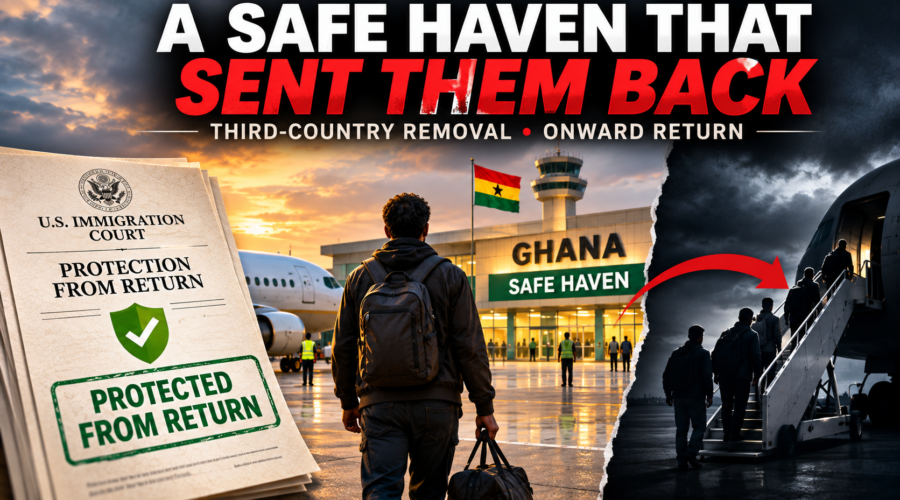
Commentary. This is the Coalition’s argued reading of the law and the record, and the fourth of seven parts. The court orders, sworn declarations, statements and reports it relies on are linked where they are discussed and listed at the end, and every quotation is taken from those documents. It is not advice.
An investigative legal series · Part 4 of 7
Third-Country Deportations: The Law, the Loopholes, and the Risk of Torture
The series follows the Coalition’s commentary of 26 October 2026, Third-Country Removal Is a Pretext for Refoulement. Each part can be read on its own.
- Part 1A Criminal Conviction Does Not End Protection Against Torture
- Part 2Removal to a Third Country: What Nasrallah v. Barr Permits, and What It Does Not
- Part 3Out of Public View: The Detainee Locator Policy and Access to Counsel
- Part 4The Country That Was Supposed to Be Safe Sent Them Back (this article)
- Part 5Payments to Other Governments, and the Safeguards That Should Come With Them
- Part 6Iranian Nationals and the Risk of Return to Torture
- Part 7The Legal Obligations That Continue After Deportation
Ghana offered West Africans deported from the United States a safe haven. People protected by American immigration judges say it sent them to the very countries those judges had ruled out. What the record shows, how the government answers it, and when a third-country removal becomes refoulement by another route.
In 2012 an immigration judge ruled that Moussa Diawara could be deported from the United States, but not to Mali, where the judge found he would likely be persecuted. He stayed, worked, and raised two children who are United States citizens. On 11 July 2026, ICE agents were waiting for him at his home near Houston when he returned from a night shift. On 31 July he was flown to Ghana, a country he had never visited. According to the account he gave CBS News, he and others were held in a hotel under armed guard and not allowed to make telephone calls, and within days Ghanaian officials put him on a flight to Mali. When 60 Minutes reached him in August, he was homeless and in hiding there.
His was not a single misfortune. CBS obtained the names of all 63 people on his flight, which left Texas on 30 July and stopped in Sierra Leone and the Central African Republic before landing in Ghana. Of the 19 sent to Ghana whom it reached, 17 said they had been sent on, against their will, to countries that United States immigration judges had ruled they should not be returned to, among them Niger, Mali, Nigeria, The Gambia and Guinea. The same pattern appears in sworn declarations filed in two federal courts, in a federal court’s orders, and in a report by Human Rights Watch.
This part sets that record beside the government’s answers and the governing law. It does not ask whether the United States may remove a protected person to a genuinely safe third country; Part 2 explained that it may. It asks what follows when the country chosen has described return home as part of the arrangement and, on the record, has carried it out without the consent of the people returned.
What Ghana said it would do
Ghana’s President, John Dramani Mahama, confirmed the arrangement on 10 September 2025. According to his Foreign Minister, Samuel Okudzeto Ablakwa, the United States had asked Ghana to receive some West African nationals, and Ghana agreed, “provided they were nationals of West African countries.” The minister described the decision as humanitarian and Pan-African, said that Ghana “has not received and does not seek any financial compensation or material benefit,” and said that the people arriving would be vetted so that “convicted hardened criminals” were not admitted. He also described the purpose as offering “temporary refuge where needed.” (Ghana News Agency; Information Services Department.)
Two features of those statements matter here. First, from the beginning, onward return was part of how the arrangement was described: the government’s own account of the first group of fourteen was that nationals of Nigeria and The Gambia “had been assisted to return to their respective countries.” Second, the minister presented the arrangement as protective. In remarks published on 17 September 2025, which the Coalition has transcribed and linked, he said Ghana was “offering ourselves as a safe haven,” that arrivals could remain for ninety days without a visa under the regional free-movement rules, and that Ghana would pay for travel home for anyone who chose it. In a television interview published the same day he said that everyone who had arrived by then had said they wished to go home, and that Ghana was facilitating it.
Ghana has been a party to the Convention Against Torture since 2000. Its public statements, read together, describe a country of temporary refuge with a voluntary path home. The record of what happened to people who held American protection describes something different.
What happened to the people sent there
The accounts below come from different kinds of source, and each is identified as what it is.
- The first flight, 5 September 2025. Patrick Taurel, an attorney who represents eleven of the fourteen people on the flight before the UN Committee Against Torture and represented five of them in federal court in Washington, states in a sworn declaration filed in the D.V.D. litigation in Massachusetts that, “To the best of my knowledge,” at least ten of the fourteen had been granted fear-based protection against return to their countries of origin, and that when several of them said they feared removal to Ghana, “U.S. officials simply told them they were following orders to effectuate their deportations to Ghana, and once in Ghana, they would be sent on to their countries of origin.” One of them, K.S., protected under the Convention against return to The Gambia, states in his own declaration, attached to Mr Taurel’s, that he told Ghanaian officials “that I wanted to stay in Ghana for my safety,” and that an official “just told me that my final destination was The Gambia, based on orders from ICE officials and his Ghanaian superiors.” He was sent there on 10 September 2025. Others, according to the declaration, were driven to the border and forced into Togo. The Coalition reported the filing in January 2026.
- A nurse from Maryland, November 2025. Rabbiatu Kuyateh had won withholding of removal to Sierra Leone on 17 September 2025. Her attorney, Hannah Bridges, states in a sworn declaration that on 30 September 2025 she asked in writing for a fear screening as to twenty-five countries, Ghana among them, and that none took place. Ms Kuyateh was flown to Ghana on 5 November. On 11 November Ghanaian immigration officers removed her from a hotel; she was held overnight at the airport and then flown to Sierra Leone, where, the declaration states, she went into hiding. Part of the removal from the hotel was filmed. The Coalition set out her case in full.
- A man protected by deferral, May 2026. Etinosa Osahon held deferral of removal under the Convention as to Nigeria. A federal court in California recited the account in his petition: that he was detained at a scheduled ICE appointment on 21 May 2026, that “[n]o officer ever took his fear claim, and no screening interview ever took place,” and that after he reached Ghana on 28 May, his group was taken across the border into Togo “on foot, through the bush, avoiding any official crossing point,” where “[t]he escorting Ghanaian officer instructed the driver to carry the group to Lagos, Nigeria.” He refused to board and was left at the roadside in Togo. Osahon v. Mullin, No. 2:26-cv-09121 (C.D. Cal. Aug. 28, 2026) (order). Under the court’s later orders the government arranged his return, and his counsel told the court on 15 October 2026 that he was back in Los Angeles; a hearing on whether the government should be held in civil contempt in connection with the terms of his return is set for 4 December 2026 (docket, ECF Nos. 70, 73, 75).
- The flight of 31 July 2026. Third Country Deportation Watch, a joint project of Human Rights First and Refugees International, records that the nationals of Nigeria, Guinea, Sierra Leone and Niger on the flight “all had been granted protection from removal to their home countries,” and that the Nigerians among them were returned to Nigeria within twenty-four hours; the Coalition reported it in September. CBS found that Mr Diawara held withholding of removal, “and so did dozens of others on his deportation flight.” Its accounts of seventeen onward removals come from the same flight.
- The overall picture. Human Rights Watch reported on 8 October 2026 that the United States had expelled more than 500 people to African countries other than their own between 20 January 2025 and 5 August 2026, and that Cameroon, Equatorial Guinea and Ghana “sent some people onward to risk of persecution or torture in their home countries.” Meredyth Yoon, litigation director of Asian Americans Advancing Justice-Atlanta, told the organization in September 2026 that by then Ghana had sent nearly everyone the United States had transferred there to their home countries: “We know of only one person permitted to stay in Ghana.”
These are accounts, sworn statements and judicial recitals, not findings after a trial. They are also consistent with one another, they span more than a year, and they include statements attributed to United States officials themselves. Ghana’s government has given a different account of consent, in the minister’s statement that the people who had arrived wished to go home; the sworn statements above say otherwise for the people they describe. The Coalition presents the record as it now stands.
How the government answers
The government’s position deserves to be stated in its own terms. In a statement to CBS, the Department of Homeland Security said that Ghana had provided “diplomatic assurances” for Mr Diawara’s safety, and it questioned the credibility of his fear of persecution in Mali. James Percival, whom CBS described as the Department’s top lawyer, said he was not aware of any cases in which Ghana had sent people on against their will. Told that Mr Diawara believes the United States coordinated his onward removal, or at least knew of it, he said he had not been aware of that, adding: “That is not my understanding of how this works.” Asked whether people were returning voluntarily, he offered two possibilities: that they chose to go home and “might not always be truthful about the fact that they consented,” or that “the foreign government applied their own procedures and, consistent with international law, determined that it was acceptable to return them home.”
Shown the medical document Mr Diawara said United States officials gave him on the flight, which listed his destination as “SHRC Mali,” and two bag tags that CBS describes as issued by the Department and that also listed Mali, Mr Percival said: “He was flown to Ghana, but I can’t speak to why that piece of paper says that.” The Department later said that the bag tags were “produced by contractors” who “are not part of the process that determines…the destination,” and that the medication form was a “clerical error.” Ghana’s government declined to comment.
The government also frames the program as a matter of public safety and of law. “This administration is following the law that Congress has passed,” Mr Percival said, and he told CBS that third countries such as Eswatini and South Sudan have accepted people with records for serious violent crimes whose own countries refused to take them back. He did not name Ghana in that answer. For Mr Diawara’s flight, which went to Ghana, CBS’s review found that 62 percent of those aboard had no criminal record, 19 percent a traffic violation, and 19 percent a criminal charge or conviction. As Part 1 explained, a criminal record bears on whether a person may be removed, not on whether he or she may be sent to torture.
In court the government has made a fuller legal case. In D.A. v. Noem, the federal case in Washington brought by people on the first flight, the court recorded the government’s argument that the plaintiffs “were properly sent there pursuant to an agreement with Ghana, which agreed to take them,” that their injuries “cannot be redressed by this court,” that the relief they sought “would improperly insert the judiciary into sensitive issues of foreign affairs,” and that their claims were foreclosed by their membership in the class certified in D.V.D. (ECF No. 41, at 11, 15). In Mr Osahon’s case it relied on the review provisions of the immigration statute, on the Foreign Affairs Reform and Restructuring Act, on Munaf v. Geren and on the Massachusetts class action (ECF No. 19, at 3). Its reliance on assurances has a regulatory footing. Under 8 C.F.R. § 1208.18(c), the Secretary of State may forward assurances “that an alien would not be tortured there if the alien were removed to that country,” and once the Attorney General determines that they are sufficiently reliable, the person’s Convention claim “shall not be considered further” by an immigration judge, the Board of Immigration Appeals or an asylum officer. The Department’s guidance of 30 March 2025 provides that where the State Department believes a country’s assurances to be credible, “the alien may be removed without the need for further procedures” (guidance, at 2).
Each of these answers raises a point that a court would weigh. A transfer to a country that has given assurances is not unlawful on that account alone. A return that is genuinely voluntary is not refoulement. Errors in paperwork happen. Questions of jurisdiction are real, and courts have answered them differently. But the answers do not engage the evidence that matters most: an exchange in court, in September 2025, in which government counsel accepted that Ghana appeared to be violating its assurances on the facts the plaintiffs alleged; sworn statements that American officials told people Ghana would send them home; and a pattern of onward removals that continued after repeated warnings. And the regulation on which the assurances rest addresses whether a person would be tortured in the country of destination itself. It does not, in terms, address what that country may do next.
The assurances
The arrangement rests on a diplomatic note. In a note dated 1 August 2025, of which the Coalition keeps a copy, Ghana’s Ministry of Foreign Affairs expressed its willingness “to consider accepting the transfer from the United States to Ghana of third-country nationals from West African countries” and retained “complete discretion to accept or reject the transfer of any given individual.” The State Department published the note in July 2026; Third Country Deportation Watch describes it as “disclosed, and then removed from view, by the State Department.” The note gives two assurances. The first is that Ghana “intends to treat any third-country nationals transferred from the United States to Ghana in a manner that is consistent with its obligations under” the Refugee Convention and its 1967 Protocol, the OAU Refugee Convention and the Convention Against Torture, as well as Ghana’s Constitution, “laws, regulations, and immigration and visa policies.” The second is that the people transferred “would not be subjected to persecution on account of race, religion, nationality, membership in a particular social group, or political opinion, or torture in Ghana or in any country to which the Government of Ghana may further transfer them.”
The note matters for two reasons. It shows that onward transfer was contemplated from the start, since the second assurance is framed around it. And it sets a standard against which Ghana’s conduct can be measured. The note promises an outcome rather than a procedure: that no one transferred would be persecuted or tortured, wherever Ghana sent them. Return to the very countries American judges had ruled out puts in issue the one thing the note promised would not happen. Whether anyone has since been persecuted or tortured the public record does not show, although several of the people described above say they are in hiding.
On 13 September 2025, eight days after the first flight and on the day the court ordered it, the State Department’s Senior Bureau Official for African Affairs, Jonathan G. Pratt, made a sworn declaration in D.A. v. Noem. He stated that the United States Embassy in Ghana “has corresponded with the Government of Ghana regarding the removals of 14 individuals,” and that “[p]rior to these removals, the U.S. government received diplomatic assurances from the Government of Ghana, communicated to the U.S. government by diplomatic note.” He added: “As of the time of this filing, I am not aware that the Department of State, including through the U.S. Embassy in Ghana, has made any additional efforts to keep Plaintiffs from being removed from Ghana to their country of origin or other countries where they fear persecution or torture.” (Declaration of Jonathan G. Pratt ¶¶ 4-5, executed Sept. 13, 2025, docketed Dec. 10, 2025, ECF No. 50.) The minority staff of the Senate Foreign Relations Committee reported in February 2026, as a general finding not confined to Ghana, that the State Department “is not tracking foreign government compliance with diplomatic assurances or enforcing agreement terms” (At What Cost?, at 5). What the public record does not show is whether the United States told Ghana which arrivals held protection against which countries, or what it did once told that the assurance was not being kept. Those facts are in the government’s hands.
When a third-country removal becomes refoulement by another route
Article 3 of the Convention Against Torture provides that no State Party “shall expel, return (refouler) or extradite a person to another State where there are substantial grounds for believing that he would be in danger of being subjected to torture.” The UN Committee Against Torture reads that duty to reach transfers in a chain: a person at risk “should never be deported to another State from which the person may subsequently face deportation to a third State in which there are substantial grounds for believing that the person would be in danger of being subjected to torture.” General Comment No. 4, ¶ 12. The Committee’s general comments do not bind the United States, which applies its own more-likely-than-not standard. The notice an immigration judge gives on granting deferral tells the person that he or she “may be removed at any time to another country where he or she is not likely to be tortured.” 8 C.F.R. § 1208.17(b)(2).
Many of the people in this record, however, were protected against persecution rather than torture. Ms Kuyateh and several of the people described in the Taurel declaration held withholding of removal under 8 U.S.C. § 1231(b)(3), and the judge in Mr Diawara’s case found that he would likely be persecuted in Mali. Section 1231(b)(3) forbids removal “to a country if the Attorney General decides that the alien’s life or freedom would be threatened in that country” on account of race, religion, nationality, membership in a particular social group or political opinion. That protection corresponds to article 33 of the Refugee Convention, which binds the United States through the 1967 Protocol and provides that no State shall return a refugee “in any manner whatsoever to the frontiers of territories where his life or freedom would be threatened.” The United Kingdom Supreme Court has noted that the courts of that country have long read article 33 as prohibiting “not only the direct return of refugees to the country where they fear persecution, but also their indirect return via a third country” (AAA, [2023] UKSC 42, ¶ 20). The American regulations permit removal to a country other than the one ruled out: “Nothing in this section or § 1208.17 shall prevent the Service from removing an alien to a third country other than the country to which removal has been withheld or deferred.” 8 C.F.R. § 1208.16(f). They do not address onward removal in terms. Congress, for its part, declared that “[i]t shall be the policy of the United States not to expel, extradite, or otherwise effect the involuntary return of any person to a country in which there are substantial grounds for believing the person would be in danger of being subjected to torture, regardless of whether the person is physically present in the United States.” (Foreign Affairs Reform and Restructuring Act of 1998, § 2242(a), as quoted in D.A. v. Noem, ECF No. 41, at 6.)
American courts have addressed the problem, but none has yet resolved it. In April 2025, granting a preliminary injunction in D.V.D., the district court in Massachusetts accepted that it “may not question the substance of diplomatic assurances endorsed by the Executive,” but observed that “blanket assurances offer no protection against either torture by non-state actors or chain refoulement, whereby the third country proceeds to return an individual to his country of origin.” (Order of Apr. 18, 2025, ECF No. 64, at 42-43.) The Supreme Court stayed that injunction in June 2025. The district court later set the government’s guidance aside, in a judgment of 25 February 2026 that the First Circuit largely affirmed on 18 September 2026; on 29 September the Supreme Court stayed the district court’s order and judgment and granted review, with three Justices noting that they would deny the stay. One of the questions it will decide is “[w]hether the Government’s Guidance on third-country removals is unlawful under 8 U. S. C. §1231(b), the Due Process Clause, or FARRA/CAT and its implementing regulations,” and argument is set for 9 December 2026 (docket, No. 26-426).
One federal court has framed relief in terms of onward transfer. In September 2026, in Mr Osahon’s case, the court in California enjoined the government from acting to effect his removal “to Nigeria, or to another country if Defendants know or reasonably should know that a further transfer to Nigeria is contemplated or reasonably foreseeable.” (Preliminary injunction of Sept. 10, 2026, ECF No. 19, at 3.) The order is limited. It protects one person; it rests on the rules governing revocation of supervision and termination of deferral and on due process (ECF No. 12, at 12-15); and it states that “[n]othing in this Order requires Defendants to command or control a foreign sovereign.” No United States court has yet held the government responsible for onward removal by the country a person was sent to, as the Coalition’s commentary of 26 October acknowledged. In the Coalition’s reading, the treaties require the same knowledge-based inquiry the California order used.
Courts abroad have asked a similar question. The United Kingdom Supreme Court held in 2023 that “the evidence establishes substantial grounds for believing that there is a real risk that asylum claims will not be determined properly, and that asylum seekers will in consequence be at risk of being returned directly or indirectly to their country of origin” (AAA, [2023] UKSC 42, ¶ 105). The vocabulary differs from the California order, but the inquiry is the same: what the sending State knew, or should have known, about where the transfer would lead.
What the United States knew, and when
On that inquiry the record is substantial, and part of it comes from the government itself. At a hearing on 12 September 2025, government counsel told the federal court in Washington that the State Department had received “a diplomatic note indicating assurances from the Ghanaian government,” and that Ghana would “make sure that if they were to be taken to another country that they would not take them to a country where they would be tortured.” One plaintiff had already been sent home. Asked by the court whether Ghana appeared to be violating the assurances it had given, counsel answered that “based on the plaintiffs’ allegations it seems that is correct.” In her opinion of 15 September 2025, Judge Tanya S. Chutkan recorded that the government had “agreed that this practice ‘is not okay,’” while maintaining that the United States “does not have the power to tell Ghana what to do.” Writing before the note was public, she described the arrangement as “what appears to be a hasty and unwritten agreement with Ghana, which has indicated its intention to return Plaintiffs to their home countries where Defendants agree they will almost certainly be persecuted,” and wrote that the government’s actions “appear to be part of a pattern and widespread effort to evade the government’s legal obligations by doing indirectly what it cannot do directly.” (D.A. v. Noem, No. 1:25-cv-03135 (D.D.C. Sept. 15, 2025), ECF No. 41, at 3-5, 9-10.) She denied relief because she concluded that the court could not order the government to direct a foreign government, not because the danger was doubtful; the case was closed on 21 January 2026.
The warnings that followed are a matter of record. The State Department’s declaration of 13 September 2025, quoted above, recorded no further effort to prevent onward removal. Ms Kuyateh’s lawyer named Ghana in writing as a feared country five weeks before her removal. The Taurel declaration was filed in Massachusetts in December 2025. On 12 June 2026 the UN Committee on Migrant Workers, in its concluding observations on Ghana, said that the reception, detention and onward transfer of these individuals may have exposed them to direct, indirect or chain refoulement (CMW/C/GHA/CO/2, ¶ 48).
The flights continued. Third Country Deportation Watch lists transfers to Ghana on eleven dates from 5 September 2025 to 12 October 2026 and estimates that about 135 people have been sent there; its summary line gives the number of flights as nine, and the two figures have not been reconciled. An attorney told CBS that the government had been warned about Ghana in a lawsuit the year before, and CBS reports that ten more flights followed. The counts differ. The direction of the evidence does not.
No document recording an instruction from an American official to Ghana to send a particular person home is public. One sworn account, K.S.’s, says a Ghanaian officer cited “orders from ICE officials”; the argument here does not depend on it. On the knowledge-based inquiry described above, the question is whether onward removal was contemplated or reasonably foreseeable. By the middle of 2026, on what government counsel accepted in court in September 2025, on the State Department’s own declaration, and on the sworn accounts of the people sent there, it was at the least reasonably foreseeable.
Ghana’s own responsibility
Ghana is responsible for its own conduct. A State that accepts a person and then sends him or her to a country where torture is likely answers for that act under the Convention it has ratified. The African Commission on Human and Peoples’ Rights has addressed States in Ghana’s position directly: “African States must not conclude or maintain migration partnerships when they know, or ought reasonably to know, that such agreements entail a real risk of serious human rights violations” (Resolution 645, 30 October 2025, ¶ 1), and in the same resolution it stressed that such arrangements “cannot delegate, transfer, or dilute the international obligations of States Parties under the African Charter and international law, particularly the principle of non-refoulement.” The UN Committee on Migrant Workers addressed its observation of June 2026 to Ghana. Ghanaian courts have been asked to intervene. In September 2025, eleven of the people on the first flight applied to the High Court in Accra for habeas corpus and an injunction against their onward removal, as the Coalition reported at the time; most were out of the country before the application could be heard. On 7 October 2025 Democracy Hub asked the Supreme Court of Ghana to declare the arrangement void for want of parliamentary ratification.
Ghana’s responsibility for what it did does not displace the responsibility of the United States for what it began. The general law of State responsibility provides that where several States are responsible for the same internationally wrongful act, “the responsibility of each State may be invoked in relation to that act,” and that a State which aids or assists another in such an act, “with knowledge of the circumstances,” is itself responsible (ILC Articles on State Responsibility, arts. 16, 47(1)). In the Coalition’s reading, those principles apply here. The United States chose the destination, transported the people, held the information about their protection, and received the assurances on which the transfers rested. Where onward removal was foreseeable, the first transfer is the act from which the harm followed.
Conclusion: the first destination is not the end of the inquiry
The law permits the United States to remove a protected person to a safe third country. In the Coalition’s reading, neither the Convention nor the Refugee Convention permits it to treat the first landing as the end of its obligations. A removal that predictably delivers a person, through another government, to the country an American judge ruled out is not made lawful by the stop in between.
Ghana was described to the world as a safe haven. For the people documented here, it functioned as a point of transfer. The government has answered with an assurance that, on the facts the plaintiffs alleged, its own counsel accepted Ghana appeared not to be keeping, and with the suggestion that some returns may have been chosen. Those answers can be tested, and the records that would test them, the communications with Ghana, the passenger manifests, the instructions given on the flights, are in the government’s hands. Until they are produced, the evidence points one way, and the prohibition on refoulement, which binds both governments, asks the United States to act on it.
This page draws on the Convention Against Torture, the Refugee Convention and its Protocol, the UN Committee Against Torture’s general comment, the concluding observations of the UN Committee on Migrant Workers, the International Law Commission’s articles on State responsibility, federal statutes and regulations, orders of three federal district courts and the Supreme Court’s docket, sworn declarations filed in two of those courts, a decision of the United Kingdom Supreme Court, a resolution of the African Commission on Human and Peoples’ Rights, Ghana’s diplomatic note of 1 August 2025 and other statements of the Government of Ghana, a Senate minority staff report, a Human Rights Watch report, the records of Third Country Deportation Watch, and CBS News reporting, and says which is which. The Coalition checked each quotation against the linked document on 8 November 2026. Accounts given to reporters and in declarations are identified as such; they are not findings after trial. The conclusion is the Coalition’s. It is not advice, and the Coalition does not represent individuals.
Authorities and references
- Treaties and treaty bodies: Convention Against Torture and Other Cruel, Inhuman or Degrading Treatment or Punishment art. 3, Dec. 10, 1984, S. Treaty Doc. No. 100-20, 1465 U.N.T.S. 85 (UN Treaty Series text; status of ratifications, including Ghana and the United States); Convention Relating to the Status of Refugees art. 33, July 28, 1951, 189 U.N.T.S. 150 (text), and Protocol Relating to the Status of Refugees, Jan. 31, 1967 (status); Comm. Against Torture, General Comment No. 4 (2017) on the Implementation of Article 3 of the Convention in the Context of Article 22, ¶ 12, U.N. Doc. CAT/C/GC/4 (Sept. 4, 2018) (UN document); Comm. on Migrant Workers, Concluding Observations on the Second Periodic Report of Ghana, ¶ 48, U.N. Doc. CMW/C/GHA/CO/2 (June 12, 2026) (UN document); Int’l Law Comm’n, Articles on Responsibility of States for Internationally Wrongful Acts arts. 16, 47 (2001) (text).
- Statutes and regulations: 8 U.S.C. § 1231(b)(3) and Foreign Affairs Reform and Restructuring Act of 1998, Pub. L. No. 105-277, div. G, § 2242(a), 112 Stat. 2681-822 (note to 8 U.S.C. § 1231) (U.S. Code); 8 C.F.R. § 1208.16(f) (eCFR); 8 C.F.R. § 1208.17(b)(2) (eCFR); 8 C.F.R. § 1208.18(c) (eCFR); U.S. Dep’t of Homeland Sec., Guidance Regarding Third Country Removals (Mar. 30, 2025), filed in D.V.D., ECF No. 43-1 (the Coalition’s copy).
- Federal courts: D.V.D. v. U.S. Dep’t of Homeland Sec., No. 1:25-cv-10676 (D. Mass.), order of Apr. 18, 2025, ECF No. 64, at 42-43 (order), reported at 2025 WL 1142968, stayed, 145 S. Ct. 2153 (2025); judgment of Feb. 25, 2026, aff’d, No. 26-1212 (1st Cir. Sept. 18, 2026), stayed and cert. granted, No. 26-426 (U.S. Sept. 29, 2026) (Supreme Court docket); Declaration of Patrick Taurel (Dec. 8, 2025), with the declaration of K.S. as Exhibit A, ECF No. 233-7 (declaration), and Declaration of Hannah Bridges (Dec. 4, 2025), ECF No. 233-8 (declaration); D.A. v. Noem, No. 1:25-cv-03135 (D.D.C.), memorandum opinion and order of Sept. 15, 2025, ECF No. 41 (opinion), and Declaration of Jonathan G. Pratt ¶¶ 4-5 (executed Sept. 13, 2025), ECF No. 50 (declaration); Osahon v. Mullin, No. 2:26-cv-09121 (C.D. Cal.), order of Aug. 28, 2026, ECF No. 12 (order), preliminary injunction of Sept. 10, 2026, ECF No. 19 (order), and orders of Oct. 14, 15 and 19, 2026, ECF Nos. 70, 73, 75 (docket).
- United Kingdom: R (on the application of AAA) v. Sec’y of State for the Home Dep’t [2023] UKSC 42, [20], [105] (appeal taken from Eng.) (judgment, National Archives).
- African Commission on Human and Peoples’ Rights: Resolution on the Obligations of African States in the Context of the Externalization of Migration Governance and the Extra-Regional Transfer of Migrants to Africa, ACHPR/Res.645 (LXXXV) 2025 (Oct. 30, 2025) (resolution).
- Government of Ghana: Ministry of Foreign Affairs, diplomatic note to the Embassy of the United States, Accra (Aug. 1, 2025), as released by the State Department in July 2026 (State Department release, file 64047; the Coalition’s copy); Ghana News Agency, report of the Foreign Minister’s remarks at the Government Accountability Series, September 2025 (report); Information Services Department, statement on the first group received under the understanding with the United States (statement).
- Congress: S. Comm. on Foreign Rels., Minority Staff Report, At What Cost? Inside the Trump Administration’s Secret Deportation Deals (Feb. 2026) (report).
- Monitoring and reporting: Human Rights Watch, “To Scare People”: US Expulsions of Third-Country Nationals to Countries in Africa (Oct. 8, 2026) (report); Third Country Deportation Watch, Ghana (updated Oct. 27, 2026) (record); CBS News, 60 Minutes, transcript (broadcast Oct. 25, 2026) (transcript), and CBS News report on Moussa Diawara (Oct. 25, 2026) (report).
- On this site: Third-Country Removal Is a Pretext for Refoulement, Ghana Offered a Safe Haven. What the July 31 Flight Met Instead, She Won Her Case, and Was Deported Anyway, the federal filing on the first Ghana flight, the challenge in Ghana’s High Court, the Ghana country guide, Part 1, Part 2, Part 3.
Next in the series. Part 5, “Payments to Other Governments, and the Safeguards That Should Come With Them,” examines what the United States has paid or promised to the governments that accept people it removes, what Congress has been told about those arrangements, and the safeguards that should accompany them.