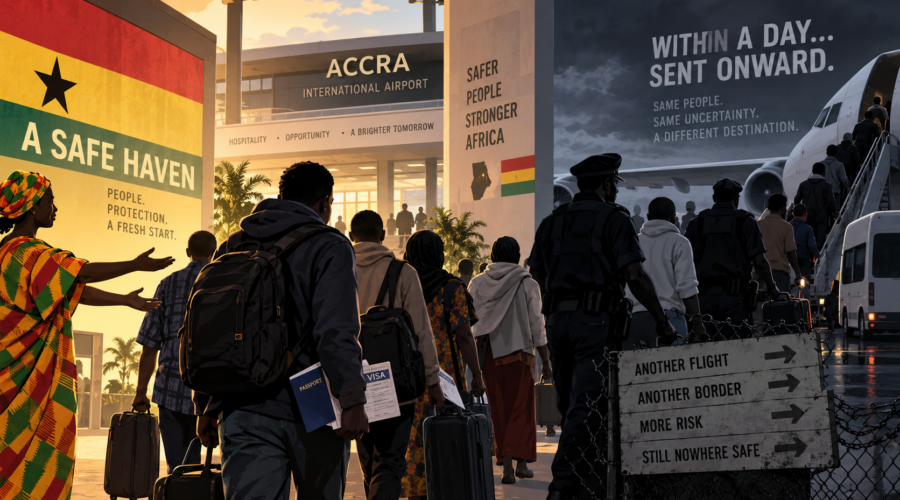
Ghana’s foreign minister said on camera in September 2025 that his country was offering itself as a safe haven for West Africans deported by the United States, that those who arrived could stay for 90 days under regional free-movement rules, and that the choice of where to go next would be theirs. Ten months later, a flight landed in Accra carrying more than thirty people, each of whom held a United States visa, and they were told they could not be safely returned home. Within a day, some of them were.
ACCRA. On July 31, 2026, an aircraft from the United States landed in Ghana carrying more than thirty West African nationals. They were citizens of Nigeria, Guinea, Sierra Leone and Niger. According to Third Country Deportation Watch, the joint project of Human Rights First and Refugees International, every one of them had been granted protection from removal to their home country by a United States immigration judge.
Ghana did not keep them. Ghanaian authorities returned the Nigerians in the group to Nigeria within twenty-four hours of arrival, and attempted to leave the Guineans at the Guinean embassy in Accra. Among those sent to Nigeria, Third Country Deportation Watch records a Christian woman who had lived in the United States for more than twenty-five years, with four United States citizen children and a disabled husband.
Sixteen months, in order
Marks an arrival from the United States.
- September 5, 2025First flight. Fourteen West Africans land in Accra. At least ten hold a United States finding that they cannot be returned home.
- September 15, 2025Foreign Minister Ablakwa tells Parliament that “convicted, hardened criminals cannot be brought into our country under this understanding.”
- September 17, 2025: The undertaking, twice on camera. Ghana is “offering ourselves as a safe haven.” Ninety days visa-free under the regional free-movement protocol; travel home paid for by Ghana if the person chooses it; no money accepted from the United States.
- Within weeks, eleven of the first group ask the High Court in Accra to stop their onward removal. Most are out of the country before the application can be heard.
- October 7, 2025: Democracy Hub asks the Supreme Court of Ghana to void the arrangement for want of parliamentary ratification.
- November 6, 2025: Second flight. Nineteen people reach Accra. Among them, M.M., protected against return to The Gambia since 2019, was flown out three days after a fear interview his lawyer was never told about.
- November 11, 2025: M.M. makes his last call to his lawyer. He describes another man being taken from the hotel to the airport. The next morning his messages stop being delivered.
- November 13, 2025: His lawyer signs a declaration for the federal court in Massachusetts recording that his whereabouts are unknown.
- February 2026: Ghana’s Supreme Court orders the Attorney-General to allow Democracy Hub’s counsel to read the agreement at the Attorney-General’s office. He may not take a copy.
- July 31, 2026Third flight. More than thirty West Africans land in Accra, each holding United States protection against return home. The Nigerians among them are back in Nigeria within twenty-four hours.
What the minister said, on the record
The undertaking is not a matter of recollection. It was recorded twice on the same day.
On September 17, 2025, GhanaWeb TV published remarks by Foreign Minister Samuel Okudzeto Ablakwa defending the decision to receive West Africans deported by the United States. In them, he places Ghana in a tradition of sheltering Africans, and then states the undertaking in terms.
Ghana has always been a safe haven, and the current generation of leaders did not think that we should sit idle as our brothers and sisters struggle and suffer, and that is why we are offering ourselves as a safe haven.
He closes by addressing Africans abroad directly, saying that any government that treats them as unwanted should know that Ghana is ready to receive them, and that they can always consider Ghana home.
In the same remarks, he sets out the terms he understood the arrangement to carry. Those who arrived could remain in Ghana for ninety days without a visa under the free-movement protocols of the Economic Community of West African States. If instead they chose to travel to their own country, Ghana would arrange it and pay for it. He also says that Ghana told the United States government it would accept no monetary consideration of any kind.
A second recording published the same day, an interview with Ablakwa on ChannelOne TV, puts the same point more sharply. Asked why Ghana should take people who are not its nationals, he answers that Ghana is not doing the United States a favor but doing its fellow Africans one, and that what is being offered is refuge. Later in the same interview, he says again that Ghana will give them a safe haven. He tells the interviewer that everyone who had arrived by then had said they wished to go home, that Ghana was facilitating it, and that a further forty people were expected within days.
Two features of that account matter for what came later. The first is that the decision was described as belonging to the person: stay for the ninety days, or be helped home. The second is that Ghana was screening who could be sent. Addressing Parliament two days earlier, on September 15, 2025, the minister had said that “convicted, hardened criminals cannot be brought into our country under this understanding.”
One further statement belongs beside those, because it complicates them. Speaking to reporters in October 2025, and reported by Agence France-Presse, Ablakwa described what Ghana had raised with the United States in the same conversation: “you want us to reverse the visa restrictions, you want [a U.S. trade deal] extended… we want you to help us to deal with this issue.” That is not a statement that money changed hands, and the minister has consistently denied that it did. It is a statement that the arrangement sat inside a wider negotiation over visas and trade.
What the flights met
The July 2026 arrivals did not encounter ninety days, or a choice.
Third Country Deportation Watch records the Nigerians sent onward within a day, and the attempt to leave the Guineans at their own country’s embassy. A separate account of the same operation was published by The American Prospect on August 31, 2026. It describes an aircraft carrying about seventy-one people in total, of whom roughly thirty were left in Ghana, ten in Sierra Leone and the remainder in the Central African Republic. On arrival at night the group was put onto buses. ICE officers and Ghanaian military officials argued over the paperwork. Ghanaian officials then sorted the passengers by nationality and moved Nigerians and Ivorians onto onward flights. Twelve people were left at a hotel in Accra under armed guard, and after three days one of them agreed to return to Guinea on a temporary travel document whose standing was unclear.
The two accounts do not match in every particular, and the differences are worth setting out rather than smoothing over. Third Country Deportation Watch names Nigeria, Guinea, Sierra Leone and Niger among those landed in Ghana. The American Prospect describes Ivorians in the group and treats Sierra Leone as a separate destination for ten people rather than a nationality within the Ghana group. The Coalition has not been able to reconcile the two lists and does not treat either as settled. What both accounts agree on is the sequence: people arrived in Ghana, were separated according to where they held citizenship, and were moved on.
That sequence is what the ninety days was supposed to prevent, and July 2026 was not the first time it happened.
The first group of fourteen arrived on September 5, 2025. Eleven of them went to the High Court in Accra to stop their onward removal; most had been moved out of the country before the application could be heard. A second flight brought nineteen people to Accra on November 5, 2025. In These Times reported that they were held first in a hotel with limited telephone access and then in a camp with none, that at least one man was taken to the airport within days and returned to his country of origin, where he went into hiding, and that a woman was hospitalized after a mental health crisis in detention. The report records that a person transferred under the arrangement attempted to take their own life.
One man’s route, sworn to in the record
What the undertaking meant in practice for one person is set out in a declaration filed in the Massachusetts case on November 14, 2025 by Ana Dionne-Lanier, a managing attorney at the Amica Center for Immigrant Rights in Washington. It concerns a client she identifies only by his initials, to protect him.
M.M. was granted withholding of removal on August 1, 2019. An immigration judge found that he faced a clear risk of persecution and torture at the hands of Gambian officials because of his activism in support of LGBTQ rights, and that he was already being targeted. He was released on an order of supervision, and the declaration states that he complied with its conditions and attended his ICE check-ins throughout. In June 2025, he was re-detained at a facility in Virginia.
On October 31, 2025, the Department of Homeland Security notified him that it intended to deport him to Ghana. His counsel wrote to ICE immediately, saying that he feared removal to Ghana precisely because of the risk of chain refoulement, and pointing to what had already happened to the September group. He was given a fear interview on November 3. His counsel was not notified of it and was not present, and learned of it only when he telephoned afterward. That same afternoon, a one-page notice recorded that he had not passed.
Three days later he was gone.
The declaration sets out the intervening days. On the evening of November 4, he called a paralegal to say he was being moved and that ICE would not tell him where. Through November 5, he did not appear in the online detainee locator, and ICE was unable to tell his counsel where he was. She filed a motion to reopen and an emergency stay of removal on the morning of November 6, and, once a third-country removal flight became known, a habeas petition in the District of Columbia later that day. By then he had been removed.
She reached him by WhatsApp on November 7 and recorded what he said had happened. He had been taken from Virginia to Texas and then to Louisiana, where officers told him he was being put on a flight to Ghana. He told them he could not go, because he knew Ghana had been sending people back to their own countries, and he held protection against return to his. He has a heart condition. He began vomiting and resisting; officers tackled him; he lost consciousness, and he was placed in a restraint jacket with his face covered. The others aboard were restrained at the wrists and ankles. He was released from the jacket, the declaration states, only once those on the aircraft realized they were nearly in Africa.
On arrival, the group was taken to a guarded hotel. Ghanaian immigration officers told them, according to the declaration, that they would all be sent back to their countries of origin. M.M. told the officers that he could not return to his country because he feared persecution and torture there.
The last call was on November 11. During it he described another man in the group being forcibly taken from the hotel to be driven to the airport, and said that he and others had recorded it. The following morning the messages were no longer being delivered. A Ghanaian attorney later told her that the group had been moved the night before under heavily armed guard to a place she could not identify.
She signed the declaration on November 13, 2025, recording that her client’s whereabouts remained unknown and that she feared he had been returned to the Gambia.
Speaking later to In These Times, Dionne-Lanier put the general difficulty in a sentence. Whatever safety the arrangement promised, she said, “there is no mechanism in place to enforce” it.
The arrangement Ghana’s own Supreme Court has been asked to void
The undertaking has a second problem, and it is a Ghanaian one.
Article 75 of Ghana’s 1992 Constitution provides that international agreements executed by or under the authority of the President are subject to ratification by Parliament. The arrangement with the United States was never laid before Parliament.
Pressed on this in the ChannelOne interview, Ablakwa answered that the arrangement is at present a memorandum of understanding rather than a full agreement, that the Attorney-General advised that a memorandum does not require ratification, and that if it were elevated to an agreement it would be taken to Parliament under article 75.
The interviewer’s objection was that the Supreme Court of Ghana has already decided the point, and read from the judgment on air.
The case is Banful and Another v. Attorney-General and Another [2017] GHASC 21, decided on June 22, 2017, which concerned the arrangement under which Ghana received two former detainees from Guantanamo Bay. The Court held, by six to one with Atuguba JSC dissenting, that the arrangement required parliamentary ratification and that the name given to the instrument did not decide the question. The Constitution, the majority held, “makes no mention of any formal distinctions that are dependent on the formality with which such an instrument is formatted or brought into being.” Where the Government of Ghana binds the Republic to obligations toward another state, Article 75 applies whether the document is called a treaty, an executive agreement, a memorandum of understanding, or a note verbale.
On October 7, 2025, Democracy Hub, a Ghanaian civil society organization led by Oliver Barker-Vormawor, filed a suit in the Supreme Court of Ghana asking it to declare the deportation arrangement unconstitutional for want of ratification, to declare the detention of the transferred people in military custody unlawful, and to declare that holding them without access to counsel or production before a court violated their rights. It sought an injunction halting the arrangement while the case was decided. Barker-Vormawor is the same advocate who appeared for the eleven victims in the High Court in Accra.
The case has moved slowly, and its central difficulty has been getting sight of the document. On November 12, 2025, the Court directed both sides to file written statements on whether the arrangement should be disclosed. It later ordered the Attorney-General to allow Democracy Hub’s counsel to inspect the agreement at the Attorney-General’s own office, without taking a copy, with liberty to file a further statement in support of the injunction application afterward. That order was reported in February 2026. The Coalition has not identified any ruling on whether the arrangement is constitutional.
The Coalition takes no position on how Ghanaian constitutional law applies here. That is for Ghana’s courts and its Parliament, and the case is before them. The point worth recording is narrower and factual. The people flown to Accra on July 31, 2026 were transferred under an instrument that has not been ratified, whose terms have not been published, and whose lawfulness was already being litigated in Ghana’s highest court when they landed.
That matters to a person arriving on such a flight for a practical reason rather than a theoretical one. An unpublished understanding gives them nothing they can point to. They cannot show an officer at the airport what they were promised, because the undertaking exists as a statement to a television camera rather than as a term of anything enforceable. The ninety days the minister described are a right under the regional free-movement protocol, which is a real and separate legal basis, but it protects only those to whom it applies, and it does not by itself stop a removal.
What was undertaken, and what the record shows
| Undertaken, September 2025 | What the record shows |
|---|---|
| Ghana is “offering ourselves as a safe haven.” | The Nigerians on the July 31 flight were returned to Nigeria within twenty-four hours of landing. |
| Ninety days in Ghana, visa-free, under the regional free-movement protocol. | Passengers were sorted by nationality on arrival and moved onto onward flights the same night. |
| Whether to stay or go home is the person’s own choice. | Ghanaian immigration officers told the November group that they would all be sent back to their countries of origin. |
| Travel home is arranged and paid for by Ghana for those who choose it. | One man accepted a temporary travel document of unclear standing after three days under armed guard at a hotel. |
| Screening to exclude convicted and hardened criminals. | Whether any screening was applied to the July 31 group is not known. |
| No monetary consideration of any kind. | No evidence of payment. The minister separately described visa restrictions and a trade deal raised with Washington in the same conversation. |
| A memorandum of understanding, said not to require ratification. | Ghana’s Supreme Court has been asked to void it under article 75. Its terms are unpublished, and counsel challenging it may read it only at the Attorney General’s office. |
Why the protection mattered
Withholding of removal and deferral of removal under the Convention against Torture are not general permission to remain in the United States. They are findings about one country. An immigration judge has determined that this person, returned to that place, faces persecution or torture, and that United States law therefore bars sending them there.
Nothing in those findings binds Ghana. Ghanaian immigration officers are not required to give effect to the conclusions of a United States immigration court, and there is no indication in the record that they were asked to.
But the findings exist, and they are evidence of an unusual kind. A formal adjudication has already examined the danger of returning that particular person to that particular country, and answered. When someone carrying such a finding is flown to a third country and moved on from there to the country named in it, the protection has produced no protection. The route was longer. The destination was the same.
That is what the principle of non-refoulement addresses, and it is why the practice is described as indirect, or chain, refoulement. Each step can be lawful in form, and the person still ends where the finding said they must not be.
What is not known
The Coalition is still investigating what became of most of the people on the July 31 flight after they were moved on. Third Country Deportation Watch’s Ghana page was last updated on August 15, 2026, and its Sierra Leone page on August 10, 2026, and neither follows the group to a conclusion. Ghana has not published a list. No court proceeding arising from this particular flight has been identified.
Nor has the Coalition established whether the screening the minister described was applied to this group, or what documents the people returned to Nigeria were traveling on. The terms of the arrangement itself remain unpublished. As matters stood at the last reported order in the Ghanaian proceedings, even the counsel challenging it could read it only at the Attorney-General’s office, without taking a copy away.
That gap is not accidental, and it is not only the Coalition’s. Adam Mahoney of Capital B News, who reported on the November group, traveled to Ghana to establish how many people had been transferred and how they were being treated. Speaking to WBUR’s Here and Now on December 2, 2025, he described an arrangement whose operation is kept from public view. Neither government has published the number of people transferred, the terms they were transferred under, or what became of them.
The Coalition would be glad to hear from anyone who can add to this record, and will publish a correction with the correction shown. Anyone who has been transferred to a third country, or whose family member has been, will find contact routes and the bodies that can be approached in each country on the Coalition’s Where to Find Help page.
Sources for this report
The two recordings are the source for everything attributed to the minister, and both are linked so that the quoted passages can be heard in context. The captions published with those recordings are automatically generated and contain transcription errors, so only passages that are unambiguous in the recording have been quoted.
- “Okudzeto Ablakwa defends Ghana’s decision to accept other African deportees from U.S. deportation,” GhanaWeb TV, published September 17, 2025. The safe haven undertaking, the ninety days, and the statement that no money was accepted. Watch.
- “Did Parliament Approve Ghana’s MoU With the US on Deportees? Ablakwa Explains,” ChannelOne TV, published September 17, 2025. The refugee undertaking, the screening criteria, the further forty expected, and the exchange on Article 75. Watch.
- Declaration of Ana Dionne-Lanier, Amica Center for Immigrant Rights, executed November 13, 2025 and filed November 14, 2025 as Exhibit E, Document 227-5, in D.V.D. v. DHS, No. 1:25-cv-10676-BEM (D. Mass.). The account of M.M. Read the declaration.
- Third Country Deportation Watch, a joint project of Human Rights First and Refugees International. Ghana, last updated August 15, 2026, and Sierra Leone, last updated August 10, 2026.
- Banful and Another v. Attorney-General and Another [2017] GHASC 21, Supreme Court of Ghana, June 22, 2017. Read the judgment on GhaLII.
- Democracy Hub v. Attorney-General, Supreme Court of Ghana. On the filing of October 7, 2025 and the disclosure orders: Courthouse News Service, reporting Agence France-Presse, October 14, 2025; MyJoyOnline on the order of November 12, 2025; and The Law Platform on the inspection order, February 2026.
- Ghana Information Services Department, on the Foreign Minister’s statement to Parliament of September 15, 2025. Read the government’s account.
- Cecile Akoeley Attiogbe Atayi, “Does Ghana’s Deportation Deal With the US Breach Constitutional Procedure?”, JURIST, November 11, 2025, on Article 75 and the Banful precedent.
- Adam Mahoney of Capital B News, interviewed by Scott Tong on WBUR’s Here and Now, December 2, 2025, on the secrecy surrounding the treatment of transferred people in Ghana. Listen.
The Coalition’s country guide to Ghana sets out the full record of the transfers and which bodies can be reached inside the country. The third-country removals project collects the decisions and the country material, and the diplomatic assurances project covers the promises the United States said it had obtained, and what courts have since said about them.
Principal sources: Third Country Deportation Watch, Ghana, last updated August 15, 2026; the two recorded interviews with Foreign Minister Samuel Okudzeto Ablakwa published on September 17, 2025 and linked above; Gillian Brockell, “What America Did to Me Is Wrong: Inside One of the Largest Third-Country Removal Flights So Far,” The American Prospect, August 31, 2026 (archived); Adam Mahoney, “Deportee Attempts Suicide as U.S.-Ghana Transfer Deal Unravels,” In These Times, November 18, 2025 (archived); Agence France-Presse, “Lawsuit filed to void Ghana-US deportation deal,” Courthouse News Service, October 14, 2025; Banful and Another v. Attorney-General and Another [2017] GHASC 21. Nothing on this page is legal advice, and the Coalition does not represent anyone and cannot take an individual case.