This is commentary. It sets out the Coalition’s view, and it names every figure’s source so that a reader can check it. It replaces an earlier version of this article, and the correction is recorded at the end.
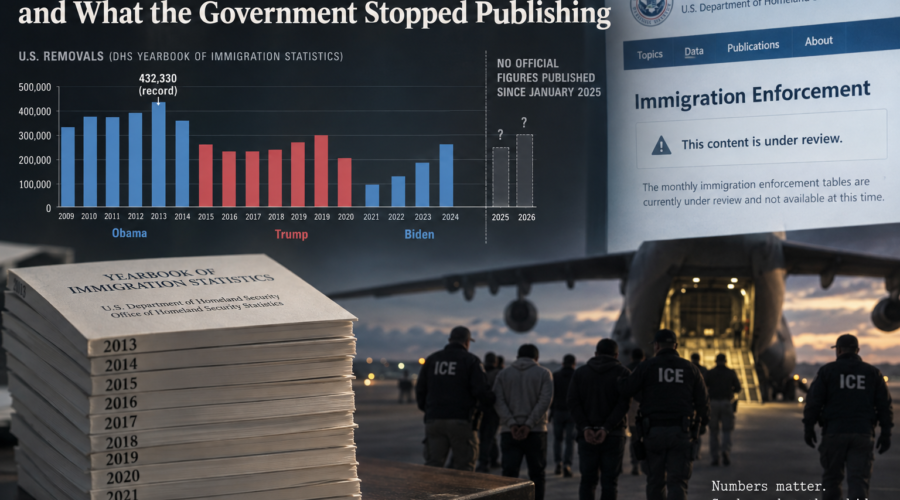
“Mass deportation” is a claim about scale. It can be tested against the government’s own statistics, up to a point. That point is January 2025, when the government stopped publishing them.
What can be checked
The Department of Homeland Security publishes total removals by fiscal year in its Yearbook of Immigration Statistics. That series counts formal removals carried out on an order of removal, by all of the department’s components, and it is the only measure that can be compared consistently across administrations.
- The record year is fiscal 2013, at 432,330. It was set under President Obama, whose administration removed between 379,740 and 432,330 people in every year from 2009 to 2014.
- The first Trump administration never came close. Its figures were 286,670 in fiscal 2017, 327,280 in 2018, 347,320 in 2019, and 234,510 in 2020. Its best year was about twenty per cent below Obama’s best, and its four-year average of roughly 299,000 was well below Obama’s.
- The Biden years show 85,450, 103,840, 183,360 and about 329,990. Those first three figures need a caveat that is usually missing when they are quoted. During that period most border enforcement was carried out as expulsions under Title 42 public health authority, which are not removals and do not appear in these numbers. There were more than 2.7 million of them across fiscal 2021 to 2023. The low removal totals are largely an artefact of that.
What cannot be checked
The Office of Homeland Security Statistics stopped publishing its monthly immigration enforcement tables in January 2025, and has carried them as under review since. There is therefore no official figure for total departmental removals for fiscal 2025 or fiscal 2026.
What exists in their place is data covering Immigration and Customs Enforcement alone, drawn from that agency’s biweekly spreadsheets and from records released under the Freedom of Information Act. On that narrower measure, fiscal 2025 produced roughly 320,000 removals, and fiscal 2026 had reached 356,389 by July 2026, a pace that the analysts tracking it describe as on course to break the Obama-era record.
That comparison should be treated with care, in both directions. The agency’s figures are narrower than the yearbook series in one respect, because they omit people processed by Customs and Border Protection who never enter the agency’s custody. They are wider in another, because the agency’s removal data include voluntary returns, voluntary departures and withdrawals under docket control, none of which are removals and none of which appear in the yearbook totals. The two effects push in opposite directions, and neither can be measured while the departmental series is withheld. A figure that is not counted the same way cannot be set beside a record and called a record.
So the position is this. Removals are rising sharply. Whether they have passed what was done between 2010 and 2014 is not known, and cannot be known from what the government currently publishes.
The comparison that can still be made
One comparison survives all of this, because it rests entirely on the published departmental series and on completed fiscal years.
In each of the four fiscal years from 2010 to 2013, the United States removed between 382,450 and 432,330 people. The highest year of the first Trump administration was fiscal 2019, at 347,320. It did not match a single one of those four years. Across its four fiscal years the first Trump administration removed about 1.2 million people, against about 1.6 million in the equivalent period under President Obama, roughly a quarter fewer.
Two qualifications belong with that, and the Coalition gives them rather than leaving them to be found. Obama’s later years fell substantially, to between 323,680 and 404,700, and the 2019 Trump figure sits inside that lower range. And fiscal 2020 was distorted by the pandemic.
Even with both, the point stands. An administration that presented itself as removing people at unprecedented scale removed, over four years, about a quarter fewer than the administration it followed. That is the opposite of the impression the rhetoric was designed to create, and it is on the government’s own published record.
Meanwhile the administration has claimed publicly that it carried out between 605,000 and 622,000 deportations in the 2025 calendar year. That figure cannot be reconciled with any published federal data and has not been explained.
What the Coalition says about this
Not that the numbers are lower than claimed. On the evidence now available they may well be higher than at any time in modern record. The Coalition says something narrower and, it believes, more serious: that a government making public claims about the scale of its enforcement, while withdrawing the statistical series by which those claims could be tested, has made verification impossible by its own choice.
The Coalition asks that the Office of Homeland Security Statistics resume publication of the monthly enforcement tables, and that the department publish total removals for fiscal 2025 and 2026 on the same basis as every year since 2008. Until it does, no claim about the scale of removals, made by anyone including this Coalition, can be verified.
Why the number was never the argument
Because the objection recorded across this site has never depended on how many people are removed.
If fiscal 2026 sets a record, nothing in the court record changes. People are still being taken at night with little or no notice, handcuffed and shackled, in one documented case held in straitjackets for as long as sixteen hours, one of them saying he has had difficulty walking since because his was secured so tightly. They are still being put aboard military aircraft without being allowed to telephone their families or their lawyers, still being told their destination only once they are in the air, and still landing in states they have no connection to, where several have been imprisoned on arrival, some incommunicado, and in one state in solitary confinement. Six federal courts have still held that removal carried out this way is intended as punishment, which the Constitution does not permit without a criminal trial.
Volume can justify urgency. It has never justified method. In death penalty cases, the number of executions carried out has never been an answer to a challenge to the way one of them is done. The same separation applies here, and it is the subject of the Coalition’s project on Punitive Third-Country Removals.
Two cautions on any of these figures
Removals cannot be compared casually. Figures described as removals sometimes include voluntary returns and departures, which are not removals. Immigration and Customs Enforcement’s own annual report for fiscal 2025 gives 442,637 on that wider basis, which is not comparable with the yearbook totals above. And the agency’s removal tables do not capture people processed by Customs and Border Protection who never pass into its custody, so an agency-only figure understates the departmental total by an amount that has historically ranged between about eighteen and thirty-one per cent, and which cannot currently be measured at all.
Correction
An earlier version of this article, published on 9 September 2026, argued that the present scale of removals remained below historic levels and that only the manner had changed. Fuller data supplied to the Coalition the same day, including the departmental yearbook series and fiscal 2026 figures running to July 2026, shows that the first half of that claim cannot be supported for fiscal 2026. It has been withdrawn and this article replaces it. The Coalition publishes its corrections.
Sources
Department of Homeland Security, Office of Homeland Security Statistics, Yearbook of Immigration Statistics, Table 39, for fiscal years 2008 to 2023: 2018, 2019 and 2020 editions. OpenImmigration.us enforcement tracker, drawing on ICE Enforcement and Removal Operations statistics, the Office of Homeland Security Statistics monthly tables and Freedom of Information Act records processed by the Deportation Data Project, current through July 2026. Transactional Records Access Clearinghouse, Taking Stock: Trump Administration Record on Detention and Removals, 24 November 2025. Austin Kocher, on the unreconciled deportation claim and the removals-versus-returns problem. On the difference between agency and departmental removal counts. Migration Policy Institute, The Obama Record on Deportations. The conditions described are recorded in D.A. v. Noem and the other decisions in the Coalition’s register.