This is commentary. Every fact in it comes from a filed court record, and the sources are named at the end.
In death penalty cases, a court may stay an execution because the method of carrying it out would be cruel, without disturbing the sentence. The two questions are separate. The sentence may stand while the method fails.
The Coalition takes the view that the same separation applies to removal, and this article is about the second question only. Whether a person should be removed is not its subject. How they are removed is.
What is being done
On 5 September 2025, five people were woken in the middle of the night at a United States immigration facility. They were citizens of Nigeria and The Gambia. An immigration judge had found, in each of their cases, that they would more likely than not face persecution, torture or death if they were returned home. One had fled after being tortured by military and police officers who told him that if they ever saw him again they would kill him.
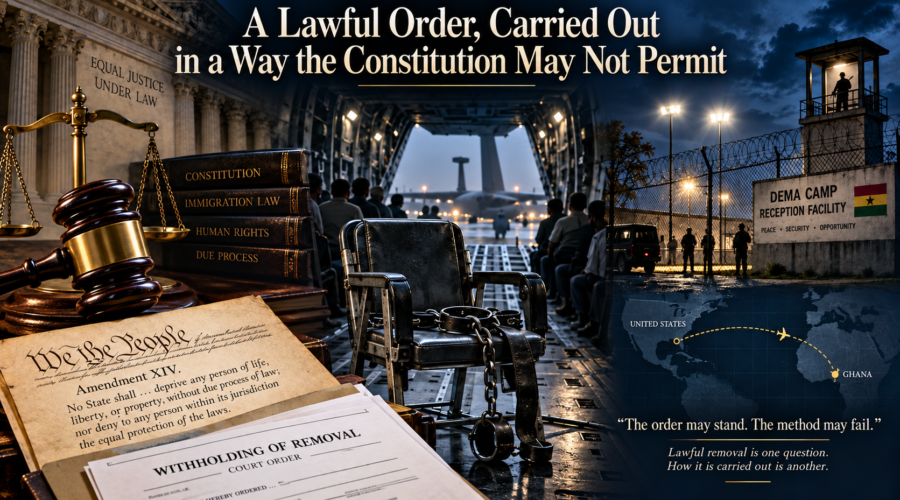
They were shackled. They were put aboard a United States military cargo plane. They were not permitted to notify their families or their lawyers. One was sent without identification documents. Some were placed in straitjackets for as long as sixteen hours, and one of them says he now has difficulty walking because his was secured so tightly. They were told they were being taken to Ghana while they were in the air. None is Ghanaian. None had named Ghana in their immigration proceedings. On arrival they were taken to Dema Camp, which the court described as a remote, open-air detention facility surrounded by armed military guards.
One of the five was returned to his home country almost immediately, and is in hiding.
What the government said about it in court
At the hearing, the government agreed that although all five hold final removal orders, they cannot lawfully be returned to their home countries. It said Ghana had assured the United States that it would not send them anywhere they were likely to be tortured. It agreed that Ghana appeared to be violating that assurance. It agreed that the practice “is not okay.” And it said that it could not prevent the return, because the United States “does not have the power to tell Ghana what to do.”
The judge refused the relief the five had asked for, holding that she had no jurisdiction to grant it. In doing so she wrote that the government’s actions appeared to be taken in disregard of its obligations to provide due process and “to treat even those who are subject to removal humanely,” and that they appeared to be “part of a pattern and widespread effort to evade the government’s legal obligations by doing indirectly what it cannot do directly.” She added that the case was “not an outlier,” that she was “alarmed and dismayed by the circumstances under which these removals are being carried out,” and that her hands were tied.
What the policy provides
The memorandum in force since 9 July 2025 has been set out in full by a federal court. Where the United States has received diplomatic assurances that the Department of State believes credible, a person “may be removed without the need for further procedures.” No notice at all. Where no such assurances exist, an officer serves a notice naming the country, but the policy provides that immigration officers “will not affirmatively ask whether the [noncitizen] is afraid of being removed to the country of removal.” The wait before removal is generally twenty-four hours, and in exigent circumstances six. A person who does not volunteer a fear within twenty-four hours is removed.
The judge who set that out held that these procedures “fall far short of what court[s] in this District and Circuit have held that due process requires,” and found that the government had misrepresented what protection the policy actually gives.
Why the manner is a question of its own
Because a removal order does not authorise everything that might be done in the course of carrying it out. That is the holding of a Supreme Court case from 1896, Wong Wing v. United States, which is still good law: Congress may expel a person, and may detain them while it does so, but it may not add punishment to the expulsion without a criminal trial.
Six federal courts between August 2025 and March 2026 have held that removal to a third country paired with imprisonment on arrival is intended to be punitive and violates due process. Five others, asked to make the same finding, declined on the records before them. None rejected the principle.
The Coalition’s view
That what is described above is torture in its effects, whatever it is called in the paperwork. It inflicts severe pain and suffering on the person and on the family left behind. It is inflicted deliberately, by officials, in the course of a state function. That the person may lawfully be removed does not answer it, any more than a valid death sentence answers a challenge to the method of execution.
The Coalition’s reasons for calling the people subjected to this victims rather than deportees, and the distinctions it keeps between a finding, a report and an allegation, are set out on its terminology page.
Sources
D.A. v. Noem, No. 1:25-cv-03135-TSC (D.D.C.), memorandum opinion and order, 15 September 2025, recorded in the register at D.A. v. Noem. The accounts of the flight are the plaintiffs’ own declarations as the court recorded them; the court made no findings on them, because it decided it lacked jurisdiction. The government’s concessions were made on the record at the hearing. The policy is set out in Elshourbagy v. Bondi, 817 F. Supp. 3d 1102. The full record of what happened in Ghana is on the Coalition’s Ghana country guide, and the wider subject is covered in Punitive Third-Country Removals. Sources: D.A. v. Noem (D.D.C., 15 September 2025) · Elshourbagy v. Bondi, 817 F. Supp. 3d 1102