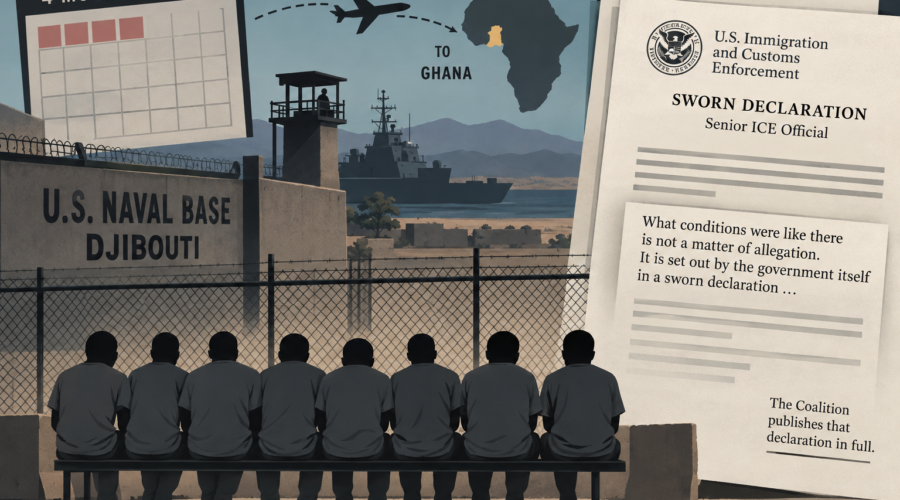
Four months before the deportation flights to Ghana, a court order stranded eight men on a United States naval base in Djibouti. What conditions were like there is not a matter of allegation. It is set out by the government itself, in a sworn declaration by a senior ICE official, and the Coalition publishes that declaration in full.
BOSTON. The clearest account of what a third-country deportation can become when it goes wrong was not written by a lawyer for the victims. It was written by the government.
On June 4, 2025, Mellissa B. Harper, then Acting Deputy Executive Associate Director of Enforcement and Removal Operations at United States Immigration and Customs Enforcement, signed a five-page declaration under penalty of perjury. It was filed the following day in D.V.D. v. U.S. Department of Homeland Security, the Massachusetts case that became the principal challenge to the procedures for deporting people to countries that were never designated in their removal proceedings.
The declaration describes eight men held in a conference room inside a converted shipping container on a naval base in the Horn of Africa, guarded by officers who were themselves falling ill, in heat that exceeded 100 degrees Fahrenheit, downwind of burn pits used to dispose of trash and human waste.
How eight men came to be on a military base in Djibouti
On May 20, 2025, United States authorities placed a group of men on a deportation flight bound for South Sudan. Most were nationals of other countries. United States District Judge Brian E. Murphy convened an emergency hearing the same day, having been told the removals were proceeding despite his April 18 preliminary injunction, which required advance notice and an opportunity to raise a fear of torture before removal to a country not previously designated.
At the hearing, government lawyers told the court that the destination of the aircraft was classified. Judge Murphy ordered the department to keep the group in custody, so as to “ensure the practical feasibility of return” if the removals were later found unlawful. NPR reported the hearing that day (archived).
Rather than return the men to the United States, the government diverted them to Camp Lemonnier in Djibouti, its principal military installation in the Horn of Africa. Two days later the White House agreed to hold them there for at least two weeks while reasonable fear interviews were conducted. The eight were nationals of Myanmar, Laos, Vietnam, Cuba, Mexico and South Sudan. NPR reported the agreement on May 22 (archived).
A deportation had been stopped by a court after the people being deported had already left United States territory. Nobody had a procedure for that. What filled the gap was a shipping container.
What the government said about the conditions
The Harper declaration was filed to explain to Judge Murphy why the arrangement could not continue. Its candor is the reason it is worth reading in full.
The conference room in which the aliens are housed is not equipped nor suitable for detention of any length.
On the room itself, the declaration records that it had none of the security apparatus needed for detention, and that if an altercation occurred there was nowhere else on site to separate the men. The restrooms allocated to them were in a separate trailer forty to fifty yards away, with six toilet stalls and six showers. Only one man was permitted to use them at a time, each movement under escort and accompanied by a search for contraband. Showers were allowed every other day, and taken at night because of the heat.
On the officers, the declaration records eleven of them guarding the group in twelve-hour shifts, five by day and six by night, sharing a trailer with three sets of bunk beds. It states plainly that they “do not have the capacity to maintain constant surveillance, custody, and care of the aliens for prolonged periods of time.” Department of Defense resources were being consumed to care for the men, disrupting the station’s operations.
On the air, the declaration describes burn pits within five miles of the base, lit at night, which produce a smog cloud over Camp Lemonnier that made breathing difficult and required medical treatment for officers suffering throat irritation. Some officers slept in N-95 masks. The pits are most active on Thursdays and Fridays. Because the temperature stays above 100 degrees by day and in the 90s at night, usually with no breeze, the smoke does not disperse.
On health, the declaration records that within 72 hours of landing the officers and the detainees began to feel ill, with coughing, difficulty breathing, fever and aching joints consistent with a bacterial upper respiratory infection that could not be tested for on site. Medical staff did not have immediate access to the medication needed. Personnel had been unable to begin antimalarial medication in the 48 to 72 hours before arrival, as recommended, and started only after landing.
On security, the declaration records that officers were warned by Defense Department officials on arrival of the danger of rocket attacks from Yemen, and that they had no body armor.
Nothing in the declaration suggests that anyone intended these conditions. It reads, rather, as an account of a system improvising after a court told it to stop, and having nowhere to put the people it had already moved. That is the point. The conditions were not a policy. They were what was left when the policy ran out.
Primary documents
These are United States government works and carry no copyright under 17 U.S.C. section 105. Each is linked to its official public source so that the account above can be checked against it.
- Declaration of Mellissa B. Harper, ICE Enforcement and Removal Operations, on conditions at Camp Lemonnier. Signed June 4, 2025, filed June 5, 2025 as Document 151 in D.V.D. v. DHS, No. 1:25-cv-10676-BEM (D. Mass.). Five pages. Read the declaration in full.
- Application for a stay of the injunction, filed by the Department of Homeland Security in the Supreme Court on May 27, 2025, seeking to stay the April 18, 2025 preliminary injunction. Read the application. Supreme Court docket No. 24A1153.
- Declaration of Patrick Taurel and exhibits, on the September 2025 flight to Ghana. Filed December 8, 2025 as Exhibit G in the same case. Twenty-two pages. Read the declaration.
- The full district court docket is on CourtListener.
The Supreme Court removed the injunction
On May 27, 2025, the government applied to the Supreme Court to stay Judge Murphy’s injunction. On June 23, the Court granted the stay while the litigation continued. The order was brief and did not resolve the merits, but it removed the requirement of advance notice and an opportunity to raise a fear of torture before a third-country removal.
Justice Sonia Sotomayor, joined by Justices Elena Kagan and Ketanji Brown Jackson, dissented. The dissent pointed to the South Sudan removals and to the danger that people could be sent to countries where they might face torture or death. On July 3, 2025, the Court granted a further motion for clarification, over a dissent by Justice Sotomayor joined by Justice Jackson, Justice Kagan having concurred.
Everything that followed in Ghana happened after that.
What followed in Ghana
On September 5, 2025, fourteen West African men and women were flown from Louisiana to Ghana. At least ten of them already held a finding by a United States immigration judge that they could not be returned to their own countries, because of a risk of persecution or torture there. None was Ghanaian.
According to the declaration of attorney Patrick Taurel, filed in the same case on December 8, 2025, Ghana subsequently removed most of the group from its territory, and in at least four cases the people concerned reached the very countries from which United States law had barred their removal. A second flight reached Ghana around November 6.
Ghana has defended the arrangement. Addressing Parliament on September 15, 2025, Foreign Minister Samuel Okudzeto Ablakwa said that it was limited to West African nationals, that no money had been requested or received, and that screening requirements had been imposed, stating that “convicted, hardened criminals cannot be brought into our country under this understanding.” The government said it was helping people avoid detention and potentially unsafe transfers elsewhere. Read the Ghanaian government’s own account of the statement.
Two failures, and the question they share
The two episodes fail in opposite directions, and that is what makes them worth reading together.
Djibouti shows what happens when a court intervenes after the people have already left the country. The removal stops, but the person does not come back. Custody continues in a place chosen for its availability rather than its suitability, at a distance from any court, and the conditions are governed by whatever is to hand.
Ghana shows what happens when no court intervenes at all. The transfer completes, custody passes to another state, and what that state does next is outside the reach of the order that protected the person in the first place.
The question underneath both is the same. A United States immigration judge finds that a person cannot safely be returned to a particular country. The United States sends that person somewhere else. What happens after arrival?
That is the point at which the protection either holds or does not, and it is the point at which the American record currently goes quiet. Withholding of removal and deferral under the Convention against Torture bar return to a named country. They say nothing about what a receiving state may do with the person afterward, and the principle of non-refoulement is not observed by a transfer that reaches the same destination by a longer route.
Neither the Harper declaration nor the Taurel declaration settles the legal questions. Governmental knowledge, the weight of any diplomatic assurances, the degree of control over a receiving state and the responsibility of each government would each require separate examination, and some of it is before the courts now.
What the two documents do establish is that the question is no longer hypothetical, and that on the Djibouti half of it the government’s own account is the most detailed one there is.
The Coalition’s third-country removals project collects the decisions and the country material. The country guide to Ghana sets out the record of the transfers and the bodies that can be reached inside the country, and the diplomatic assurances project covers the promises the United States said it had obtained, and what courts have since said about them.
Principal sources: Declaration of Mellissa B. Harper, ICE Enforcement and Removal Operations, filed June 5, 2025 in D.V.D. v. U.S. Department of Homeland Security, No. 1:25-cv-10676-BEM (D. Mass.), CourtListener; Declaration of Patrick Taurel and exhibits, filed December 8, 2025 in the same case, CourtListener; Ximena Bustillo and Scott Neuman, NPR, May 20, 2025; Jasmine Garsd, NPR, May 22, 2025; Ximena Bustillo and Bill Chappell, “Deportees are being held in a converted shipping container in Djibouti, ICE says,” NPR, June 6, 2025 (archived); Ghana Information Services Department, September 15, 2025. Nothing on this page is legal advice, and the Coalition does not represent anyone and cannot take an individual case.