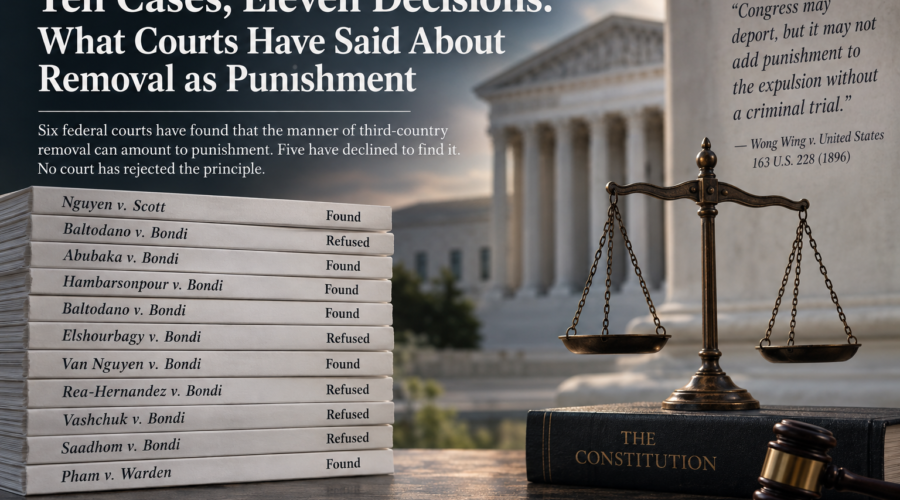
This report sets out how federal courts have answered a single question between August 2025 and March 2026: whether the way third-country removals are being carried out amounts to punishment, which the Constitution does not permit without a criminal trial. Ten cases produced eleven decisions. Six found that it does. Five declined to find it. No court rejected the principle. It is a summary of a litigation record, not advice, and the position may have moved since this article was written.
The rule the cases apply
In 1896, in Wong Wing v. United States, the Supreme Court struck down a provision of the Chinese Exclusion Act under which a person found not lawfully entitled to remain was to be imprisoned at hard labour for up to a year and then removed. The Court held that while Congress may deport those unlawfully present, it could not add to the sanction of expulsion a punishment such as imprisonment at hard labour without a trial by jury. It distinguished detention or temporary confinement pending deportation from imprisonment as punishment, and called the second an infamous punishment. The Supreme Court restated that holding in Zadvydas v. Davis in 2001.
The eleven decisions
- 21 August 2025, Nguyen v. Scott, W.D. Wash. Found. The court took judicial notice of statements by government officials acknowledging that people removed to third countries are being imprisoned, and analysed sworn declarations that men deported to South Sudan and Eswatini had been held incommunicado since arrival.
- 7 November 2025, Baltodano v. Bondi, W.D. Wash. Refused. The record before the court lacked the specificity about third-country imprisonment present in Nguyen.
- 17 November 2025, Abubaka v. Bondi, W.D. Wash. Found. The court held that the practice of third-country removal paired with imprisonment is intended to be punitive and violates due process.
- 21 November 2025, Hambarsonpour v. Bondi, W.D. Wash. Found. A second judge adopted that holding four days later and widened his order to bar removal to any country where the man was likely to face imprisonment or harm.
- 4 December 2025, Baltodano v. Bondi, W.D. Wash. Found. The same judge who had refused the claim in November granted it in December, once the missing evidence was supplied.
- 23 December 2025, Elshourbagy v. Bondi, W.D. Wash. Refused without prejudice. The petitioner was Egyptian and had not connected himself to the population or the destinations the earlier findings concerned.
- 3 February 2026, Van Nguyen v. Bondi, W.D. Wash. Found. The government offered no substantive response to the claim.
- 6 February 2026, Rea-Hernandez v. Bondi, W.D. Wash. Refused without prejudice. The court recorded that the petitioner had not substantiated his allegations and that the government had not denied them.
- 11 February 2026, Vashchuk v. Bondi, W.D. Wash. Refused without prejudice. The petitioner had no criminal record and the countries being approached were Denmark, Norway and Sweden.
- 12 March 2026, Saadhom v. Bondi, W.D. Wash. Refused. The petitioner relied on a declaration about a different population and different destinations.
- 26 March 2026, Pham v. Warden, E.D. Cal. Found. The court reached its finding on allegations the government had not denied, noting that under Rule 8(b)(6) of the Federal Rules of Civil Procedure an allegation that is not denied is admitted.
What divides them
Not the principle. Every court in this line accepted that a removal can be punitive and that the Constitution forbids it. One of the courts that refused relief recorded that “there is extensive evidence across multiple cases that the government is carrying out some third-country removals that are unconstitutionally punitive,” and refused anyway, because the law of permanent injunctions did not permit it to infer from those cases that the person before it faced the same harm.
What divides them is evidence about the destination. Three of the refusals quote the same formulation: the cases finding the practice punitive were specific to a particular population and particular destination countries, and do not extend to circumstances a petitioner has not connected himself to.
The clearest demonstration is Baltodano, which appears twice above. The same judge refused the claim on 7 November 2025 and granted it on 4 December 2025. Nothing in the law changed in twenty-seven days. The evidence did.
One caution about where this line begins
The analysis these decisions rest on was made in Nguyen v. Scott at the preliminary injunction stage. That case was voluntarily dismissed by its petitioner the following month after an agreement between the parties, and so never reached a merits decision. That does not make its findings wrong, and five courts have since adopted them on their own records. Anyone relying on this line should know where it begins.
Sources
All eleven decisions are recorded in full in the Coalition’s register of court decisions, each with its court, date, docket number, citation, judge, disposition, holding, a caution recording what the decision does not establish, and a link to the record. The pattern across them is set out in the project on Punitive Third-Country Removals. Sources: Nguyen v. Scott (W.D. Wash., 21 August 2025) · Baltodano v. Bondi (W.D. Wash., 7 November 2025), ECF 22 · Abubaka v. Bondi (W.D. Wash., 17 November 2025) · Hambarsonpour v. Bondi (W.D. Wash., 21 November 2025) · Baltodano v. Bondi (W.D. Wash., 4 December 2025), 815 F. Supp. 3d 1191 · Elshourbagy v. Bondi (W.D. Wash., 23 December 2025) · Van Nguyen v. Bondi (W.D. Wash., 3 February 2026) · Rea-Hernandez v. Bondi (W.D. Wash., 6 February 2026) · Vashchuk v. Bondi (W.D. Wash., 11 February 2026) · Saadhom v. Bondi (W.D. Wash., 12 March 2026) · Pham v. Warden (E.D. Cal., 26 March 2026)