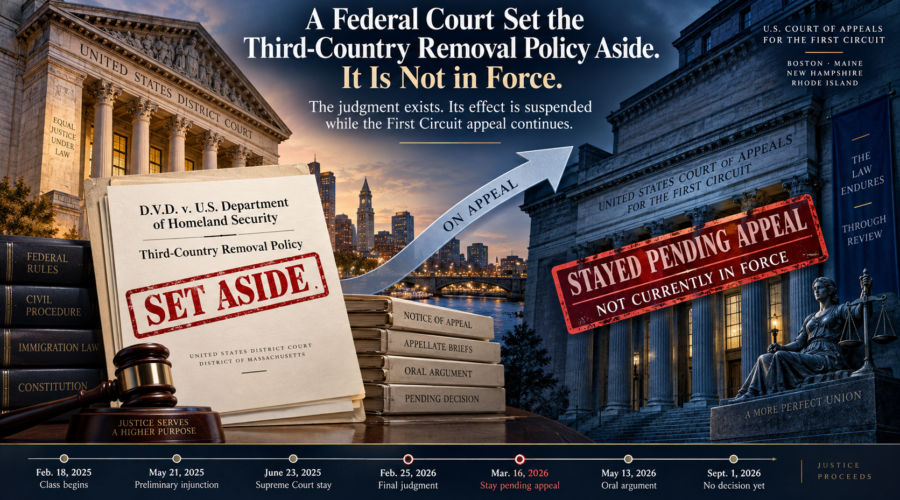
This report sets out what has happened in the class action D.V.D. v. United States Department of Homeland Security, in which a federal court set the government’s third-country removal policy aside as unlawful. It is a summary of a litigation record, not advice. The most important fact about it is that the judgment is not currently in force.
Sequence
- 18 February 2025. The date from which the certified class runs. The class covers people with final removal orders whom the Department of Homeland Security has deported or will deport to a country not previously designated as the country or alternative country of removal, and not identified in writing in their earlier proceedings.
- 21 May 2025. The court found that the government had violated the preliminary injunction it had entered, by failing to give six class members a meaningful opportunity to assert claims for protection under the Convention against Torture before removing them to a third country. The government argued that the phrase “meaningful opportunity” was ambiguous. The court answered: “To be clear, this is not one of those hard cases.”
- 23 June 2025. The Supreme Court stayed the preliminary injunction pending appeal, in an emergency-docket order that gave no reasons.
- 25 February 2026. The District of Massachusetts entered final judgment. It held that class members have the right to meaningful notice before removal to any third country, and to a meaningful opportunity to raise a country-specific claim against removal before it happens. It set the third-country removal policy aside as unlawful, and held that the policy as embodied in the March 2025 guidance is contrary to the removal statute.
- 28 February 2026. The government appealed to the First Circuit.
- 11 March 2026. The First Circuit granted an immediate administrative stay, saying it intended to rule promptly on the request for a stay pending appeal.
- 16 March 2026. The First Circuit granted the stay pending appeal. One judge of the three, Circuit Judge Montecalvo, would have denied it. The court set an expedited briefing schedule and said it intended to hold oral argument soon after briefing was complete.
- 13 May 2026. The appeal was argued before Circuit Judges Montecalvo, Howard and Aframe.
- 1 September 2026. The parties were still filing supplemental authorities. No decision has issued.
What the judgment decided
Two things. First, that people in the class are entitled to meaningful notice before they are removed to a third country, and to a meaningful opportunity to say that they fear that particular country and to be heard on it. Second, that the policy under which these removals were being carried out is unlawful, and it was set aside on that basis.
Why it is not in force
Because the First Circuit stayed it. A stay does not decide whether the judgment was right. It suspends its effect while the appeal is heard. The practical position, as at the date of this article, is that the policy the district court set aside is the policy still being applied, and has been throughout the period covered by the Coalition’s register of court decisions.
The Coalition records this plainly because the opposite impression is easy to form. A reader who hears that a federal court struck down third-country removals, and who is then removed under the policy anyway, has been misled by an incomplete account. The judgment exists. It is not operating.
What it does not decide
The judgment is about notice and the opportunity to be heard. It is not about whether removal to a third country can amount to punishment, which is a separate question that other courts have addressed and which the Coalition sets out in its project on Punitive Third-Country Removals.
Nor does the Supreme Court’s stay of the earlier preliminary injunction decide anything about the merits. Several district courts have said so, noting that it is not clear whether the Court found the government likely to succeed on its jurisdictional argument or on its substantive one, and that one of the government’s main arguments concerned the power to grant class-wide relief, which has no bearing on an individual case.
Sources
D.V.D. v. United States Department of Homeland Security, No. 1:25-cv-10676-BEM (D. Mass.); memorandum on preliminary injunction, ECF 118, 21 May 2025; final judgment, 25 February 2026. Department of Homeland Security v. D.V.D., 145 S. Ct. 2153 (2025). Appeal docketed as No. 26-1212 (1st Cir.), orders of 11 and 16 March 2026, argued 13 May 2026. The appellate docket is public on CourtListener. The status of the case as at March 2026 is also recorded in the findings and recommendations in Pham v. Warden.