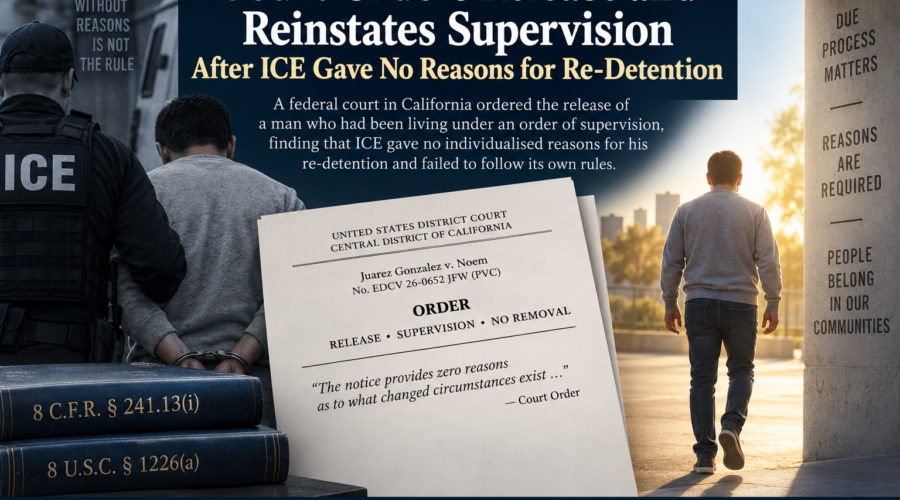
This report sets out what a federal court in California decided about the re-detention of a man who had been living under an order of supervision. It is a summary of a litigation record, not advice, and the position may have moved since this article was written.
Sequence
- 12 February 2026. Miguel Juarez Gonzalez, a citizen of Mexico who had been released on an order of supervision, filed a motion for a preliminary injunction and a temporary restraining order. He filed it himself, without a lawyer.
- 17 February 2026. The government filed its response.
- 26 February 2026. The court granted the motion, ordered his immediate release, reinstated his supervision, and barred his removal or transfer out of the district while the case continued.
- 24 August 2026. The court accepted the findings of a magistrate judge, granted the petition, and entered judgment for him.
What the regulation requires
The court set out two provisions of 8 C.F.R. § 241.13(i). Under subsection (i)(2), immigration officers may re-detain a person released on an order of supervision “if, on account of changed circumstances, [ICE] determines that there is a significant likelihood that the alien may be removed in the reasonably foreseeable future.” Under subsection (i)(3), the person must “be notified of the reasons for revocation of his or her release,” and must be given an informal interview promptly after being returned to custody, at which the person “may submit any evidence or information that he or she believes shows there is no significant likelihood he or she be removed in the reasonably foreseeable future.”
What the notice said
According to the petition, which the government did not contest, the notice given to Mr Juarez Gonzalez stated only: “This decision has been made based on a review of your official alien file and a determination that there are changed circumstances in your case.”
The court found that because the notice was not individualised, it “provides zero reasons as to what changed circumstances exist such that [Petitioner’s] removal is now significantly likely in the reasonably foreseeable future.” It added that a person cannot be expected to “respond to the reasons for revocation stated in the notification” when the notice states no reasons.
The court also recorded that the petitioner was not given the informal interview the regulation requires.
What the government said
In its response, the government wrote: “At this time, Respondents do not have an opposition argument to present.”
What was ordered
On 26 February 2026 the court ordered the government “to immediately release Petitioner from custody and restore him to the status quo prior to his detention by reinstating his supervision,” and enjoined it “from removing Petitioner to Mexico or any third country or transferring him from the Central District of California pending adjudication of his Petition.” The bond requirement was waived.
On 24 August 2026 the court granted the petition and ordered that the government is “ENJOINED from re-detaining Petitioner under 8 U.S.C. § 1226(a) unless his re-detention is ordered at a custody hearing before a neutral arbiter in which the government bears the burden of proving by clear and convincing evidence that Petitioner is a flight risk or danger to the community.” Judgment was entered the same day.
Limits of this report
These are unreported district court orders. They bind the parties to this case and no one else. The reasoning behind the August judgment is in a magistrate judge’s report and recommendation, which the Coalition has not obtained; the order adopts it without restating it. The February order rests on 8 C.F.R. § 241.13(i), while the August injunction is framed in terms of 8 U.S.C. § 1226(a), and the file does not explain the difference. The February order also records prior arrests and convictions, which are not summarised here.
Both orders and the judgment were read in full from the court’s own filings in Juarez Gonzalez v. Noem, No. EDCV 26-0652 JFW (PVC), Central District of California, Documents 13, 21 and 22. Both are recorded in the Coalition’s register of decisions.